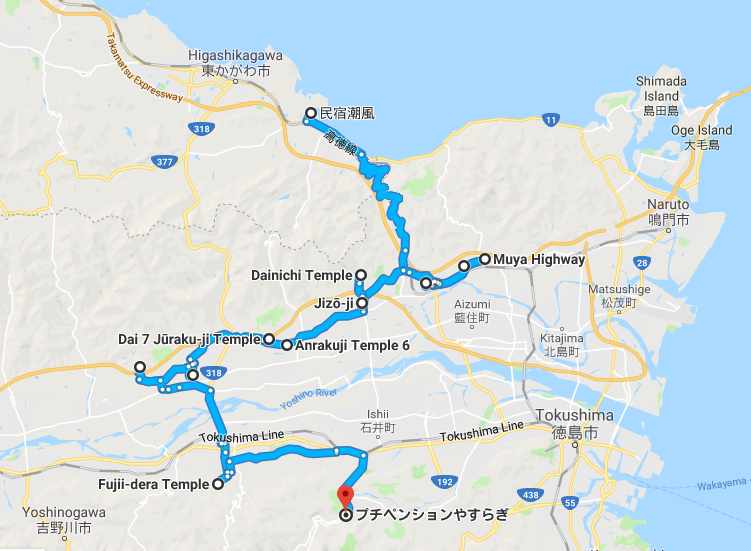
sabato 10 marzo 2018
Day 5: When we reach the ocean
Once we leave our first visit is at temple 19, where we ask for directions to a young boy on his way to school with a girl. Being able to answer our questions in English makes him visibly proud, and gives us a smile.
The visit to the temple puts us in the right mood for the day, and we start cycling through rice fields to pass a mountain range and then we continue following upstream the Katsuura and Naka rivers. The place is quite remote, and we even stop in small village where the facilities for the henroes are located in a dismissed school.
Being there during the day and comparing the quiet and silence of the moment with the laughter and kids' voices that there should have been long time ago gives a strange sense of desolation; I am pretty sure that being there at night, or even spending the night there, must be quite an experience, though I am not sure it is even allowed.
Our first leg ends in a small town where we take the rope-way bringing us up to temple 21. The view from up there is simply stunning and we are able to also get a glimpse of some late blooming sakura.
Once we get back to our bikes we travel along road 195. going up and down as the road follows the slope of the mountains, until we get close to temple 22. The now familiar fragrance of the freshly cut inoki, coming from a sawmill built along the road, recalls the refreshing memories of the ofuro we have recently enjoyed.
The kind staff at temple 22 suggests us a different way to reach back road 55, and when we find a suitable place, a rest hut built below some trees, we stop for having our lunch, as usual made of tuna onigiri, sandwiches and jelly fruit. Looking at the map we see we have two options: the first is to continue on road 55, which goes through mountains and valleys, while the second is to take a detour along the coast and rejoin road 55 later.
We choose the second option, forgetting that here in Shikoku "along the coast" doesn't necessarily mean "flat". And indeed we have to climb and descend quite a lot, with the partial compensation of amazing views. Not mentioning the emotion and rewarding feeling that we get when we finally reach the ocean after days of ride through the mountains.
Before reaching temple 23 we take a short break at Tainohama beach, where sea turtles come for thousands years to lay their eggs in the candid sand. This beach is also vividly described in a passage of "Scissors Cut Paper Wrap Stone", and I cannot avoid repeating in my mind the section I have read countless times.
When we finally reach temple 23 we realize it is getting pretty late: we still have about 40 km to go, and the sun is about to set. We give a call to the minshuku to let them know that we will be late, and start running along the almost deserted road 55. When it gets dark there are only our headlights shining in the dark while we rise and descend following the road, and the frequent tunnels just help us to better realize we are moving forward.
I am pretty sure that if we had the time and leisure to stop and look up in the sky we would get a flabbergasting view, but there is no time to idle. We quickly stop to the last convenience store in a small village few kilometers before our lodging, with the intention to buy something for our dinner. There we meet also the tenant of the minshuku, who has come along the way to check that we are ok.
We apologize with him for the inconvenience we caused and, after receiving from him the instructions on how to find it, we rush to his place. We exchange some pleasantries with the tenant about his minshuku: it looks quite off standard for an henro accommodation, and indeed is also used as lodging for surfers coming to ride the waves at the close by beach. Also this time we soak our tiredness into an ofuro, and we barely have the energies to finish our dinner before falling asleep. Today has been our longest travel so far, and probably the two hours spent on the rope-way have had their fair share on the delay we have had.
Where we slept:
Kannoura, minshuku Ikumi, 0887 24 3838
venerdì 9 marzo 2018
Day 4: Dolls in the valley
Our day starts early as usual, and before leaving the hotel we take some time to also take care of our bikes. Few drops of lubricant for the chain and some tuning for the brakes are the bare minimum for our faithful vehicles and travel companions.
The air of the early morning is chilly, and being at the bottom of the valley where the Akui river flows doesn't help the sun to warm it up. The waters of the river are crystal clear, and we constantly move from the shadows to the sun according to the turning of the road.
It feels like being in a Murakami's novel, constantly on the border between two worlds. When we then go through a small village whose only inhabitants are, apparently, stuffed dolls busy doing whatever is possible (playing shogi, sightseeing, greeting those passing by) the vibe gets really spooky.
But we have no time to enjoy the trill and we keep getting closer to the climb for temple 12. After leaving the main road and rising on a narrow mountain road, we reach the parking place at the bottom of the temple, where we leave our bikes to an old shopkeeper, thanks to a young pilgrim who helps us with the translation.
We wear our hiking shoes and start walking up to the temple: the road is steep and goes for a good length among tall trees, where we can only see rocks and vegetation surrounding us.
As soon as we reach a sunny spot, we notice 3 snakes enjoying the warmth and carefully avoid them.
After 1 hour we finally reach the temple and, while resting, we meet the Korean couple we have met yesterday. They came hiking from temple 11, and are obviously happy to have reached their goal.
Few minutes more for resting while listening to a priest chanting the Heart sutra restore our energies and we can start descending. We hitch a ride from another henro, who is doing the pilgrimage by car, and we are able to quickly reach our bikes.
After giving a small osettai to both the car driving henro and to the shopkeeper to thank them for their help, we wear back our cycling shoes and get back riding. During the descent we meet several pilgrim, joyfully walking down the road. When we cross again the doll village we hear a shamisen playing somewhere: probably this village has also some human inhabitants!
We reach temple 13 and shortly after temple 14 and 15, where we meet again our young morning helper. There we also see a bus packed with elderly pilgrims, crowding the stairs to main gate.
We stop by a tourist center to get some help in reserving a lodging for the night, and we have to convince them that we can reach our intended lodging in due time. Probably used to help walking henroes, they doubt some cycling henroes can go faster. Anyway we manage to get our booking and we can continue further.
We reach our travel companion for the coming days, road 55, and we rush to reach our lodging before sunset. We stop a person to ask for directions and he is the tenant of the minshuku, gladly taking us to destination.
There we enjoy one of the finest experience one can have: soaking into a wooden ofuro, breathing the fragrance of inoki wood and resting our legs after the day while tasting ocha and yokan. We really cannot ask for more.Once again sleep takes us quickly as soon as we lay ourselves on the tatami.
Where we slept:
Komatsushima city, minshuku Funa-no-sato, 0885 37 1127
giovedì 8 marzo 2018
Day 3: Through the Yoshino valley
Today we have a long day ahead of us: first we have to cycle past the Osaka-toge pass, then travel as much as possible in the Yoshino valley. We have no idea of how far we will get, therefore we have made no plans yet on our lodging. We will decide around lunch time, based on the progress made until then.
Few kilometers on the road 11, with a shining sea on our left, warm up our legs, then we take a turn to the right and start climbing on road 1: in the past this was the frontier between the two prefectures, and a border guardhouse was set on the path, with the pilgrims often regarded as spies or foreign agents; nowadays this is an almost neglected and narrow road, winding up to side of the mountain between trees and waterfalls.
Our only encounters are workers busy with repairing the side of the roads, for the rest of the climb we are alone with ourselves. We stop often to capture the marvelous views of the sea, and we try not to push too hard so that we can constantly progress. The fresh air of the mountain is a good tonic for our effort, and soon we reach the pass and start to descend into the Yoshino valley. From the narrow mountain road we end up on a bigger and more frequented one, where we experience the extreme education of the drivers: a long train of cars and trucks forms behind us, being risky to overtake with all the curves of the descent, and we take a stop after a while to let them proceed faster.
Once in the city of Naruto we manage to reach temple 1, where we see a large number of pilgrims preparing to begin their ohenro-san. Their faces look happy, they smile and guide each other in all the steps of the rituals: one explains how to light the incense stick, the other gives the pace in chanting the sutra, all appear to be fully charged for the challenges ahead.
From temple 1 to 3 the road is pretty easy, then a short climb takes us to temple 4 and from there to temple 5. Then we proceed further until temple 6, where we stop for our daily lunch with onigiri and sandwich. From the main gate we see a gaijin climbing down a stair, and we ask him if there is anything to see up there. He tells us it is only a small room where henroes can sleep, and then takes the chance for some small talk. He comes from the US, is walking the henro alone and, already feeling the hardness and the solitude of the walk, is considering whether he should give up or not. We share our experience so far when dealing with difficulties, then he leaves us.
Considered the progress made so far, we decide that we can climb to the other side of the mountain range delimiting it, and we look for a lodging in that area. We manage to make a reservation following the phraseology contained in the booklet, so we are settled for the night. Then we continue, finally cycling in the countryside. Whenever we stop we are at the center of the attention of some people: either for the bikes or for our height, people stops and ask us where do we come from and what we are doing. Sharing our little story with them, and getting their cheering and encouragement back, is a good way to forget the fatigue.
We reach temple 11 shortly before its closure and there we meet two gaijin: a friendly Korean couple, with whom we take some pictures, and a German girl, walking the henro after having visited the Iya Valley.
We leave the temple and rush to pass the mountain range before sunset, so that we don't have to climb in the dark. Apparently we are the only guests in the hotel, but we refrain from asking to the person at the counter if he opened just for us: we are grateful to have a roof above our head, and that is enough. After the shower we shortly enjoy the cold mountain breeze and the crickets singing all around with the frogs, then again we fall asleep and get some rest for the next day. Temple 12 is waiting for us.
Where we slept:
Ishii town, Pension Yasuragi, 088 678 0198
mercoledì 7 marzo 2018
Day 2: where we travel with the rain
That's indeed the case as long as we ride in Takamatsu, heading to the starting point of the ropeway which will take up to temple 85.
Most of the students seem surprised to see two gaijin, equipped with bright orange panniers, cycling on their same road. A group of them even greets us, probably thinking we are someone else: also the evening before, next to the hotel, some teenagers appeared amazed to see us and gave us good wishes for the match (???)
Reaching the starting station of the rope-way is a good warming up, and then we enjoy the climb on the side of a mist covered mountain.
Once we reach the top we see that the temple, and the few pilgrims being there early in the morning, is completely covered in clouds, the air is chilly but luckily it is not yet raining. A group of shopkeepers, not having customers to attend for, ask us about our trip, where do we come from and how are we liking the experience.
After chanting the sutras in the temple hall we start the descent, which proves to be challenging: the road is wet, the slope is at 21% and stretches one pin head after the other until the sea. The few cars we meet pay great attention in giving us space, and we manage to reach the bottom with just really hot rims.
When we reach temple 86 we are offered as o-settai a visit to the garden attached to the temple, which is indeed worth viewing. Its quiet appearance and the lack of crowd really inspires to sit down in meditation, but we cannot stop too long, as it starts to rain. Therefore we have to wear our rain jacket and proceed.
Temple 87 welcomes us with heavy rain, and all the henroes we meet are traveling either by bus or by car. Our glowing yellow jackets really make us stand out in the mass, and not only that.
For a while we take cover from the rain under the main gate, then decide to move on. We stop at a combini to evaluate what to do: the climb to temple 88 is pretty steep, and the wet road is not really inviting us to take the challenge.
A detour along road 10 would allow us a more quiet trip along the coast, with the inner sea at our left. We travel across a monotonous aggregate of house and small industrial areas under the continuous rain, until, after a short climb to a pass, the rain stops and we reach the sea.
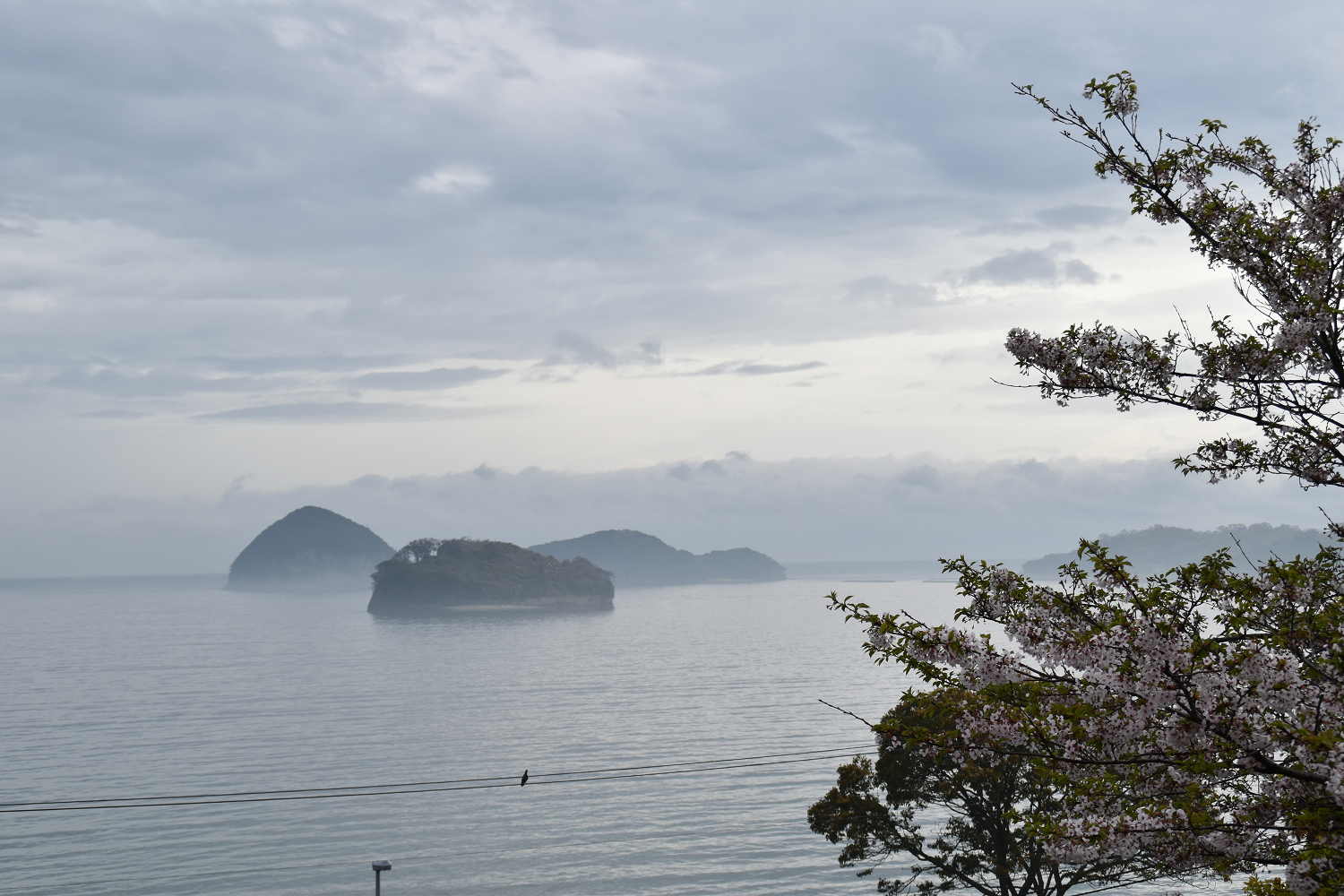
The small islands scattered in front of us, partially covered in the mist and in the clouds, is really a magnificent view and boosts our energies for the remaining of the day.
We have to make some climbing, but the rain dripping trees, the birds tweeting from the depth of the forest and the feeling of being the only humans in that stretch of land between the sea and the sky are more than enough for compensating the effort.
martedì 6 marzo 2018
Day 1: When the jet lag is an unexpected travel companion
- osame-fuda, the name slips to be given at each temple and also to those who give us gifts
- a cotton scarf decorated with the heart sutra verses
- tsue kaba, a brocade cover for the walking stick, with a bell attached to it. We don't have the stick as we are going by bike, but we hang the bell to the bike.
Getting used to cycle while following the maps and also looking at the signs spread along the way is not easy at the beginning, and we often go around looking for the right direction. When we stop at temple 76 we meet an Italian henro, with whom we exchange some chat while visiting the temple. He also offers us some sweets he received as o-settai, which are really tasty.
Along the way we meet an old man from Osaka, who is riding around Shikoku on his bike, too. Being more trained than us, and also not having to carry along our same load, he quickly disappears from our sight.
Meanwhile the sun is starting to be really hot and the jet lag is also kicking in, right in time for the climb to temple 81 and 82. We stop at about half the climb to have our lunch under a shaded rest hut, from where some stairs carved in the mountain allow walking henroes to reach the temples above.
Considering the remaining distance we have to cover before sunset, the slow pace we have kept on the way up and also the two falls we have already experienced, we decide it is safer to renounce the climb and take a detour to Takamatsu.
We reach temple 83 five minutes after its closure time, and we can enjoy the quiet surroundings while monks clean and wash around. From there we have to cycle some more time in the busy city center to reach our hotel, were we arrive scorched by the sun and really tired, looking forward for a rainy following day.
A warm shower, a tasty dinner and we are ready for a night of sound sleep.
Where we stayed
Daiwa Rionet Hotel, Takamatsu
lunedì 5 marzo 2018
Day 0: From KIX to Zentsuji
Day 0: Our trip starts from Amsterdam Schiphol, were we arrive with a train, carrying our two bikes diligently packed in a bag and then in cardboard boxes, as per air company standard. In the boxes we also put our panniers. Then 12 hours flight and we land in KIX in perfect schedule, early in the morning. After going through custom and passport control, where the inspectors are amazed to find out what our purpose for the visit is, we wait for the boxes containing our bikes to be disembarked.
Once picked them up and checked they are in good order, we reach the close-by train station, starting our journey to Zentsuji.
We have decided to go there by train and not by ferry as ferries can be canceled for bad weather, and we didn't want to take the risk.
As first step, we stop in Izumisano, where we leave the boxes at the minshuku where we will spend our last night before the departure. They kindly accepted our request for storage, and we have been lucky enough to also find two Japanese tourists on our departure from Amsterdam who helped us by calling them and confirming we were going to drop our boxes.
Once left the boxes we have to carry the bikes in their bags on our shoulders, on 3 different trains:
- from Izumisano to Shin-Osaka (with a local train)
- from Shin-Osaka to Okayama (with a Shinkansen)
- from Okayama to Zentsuji (with a local train)
Important note: some local trains have free sits wagon and mandatory reservation wagons. If you travel with your bike along, be sure to go to the free sits wagon, where you can place yourself where it is more convenient.
On the last train to Zentsuji we see Shikoku island from the bridge we cross, but also meet locals. Though they don't speak English, they understand we are going to do the Ohenro-san by bike, and they cheer us up with word of encouragement.
As we step out at the train station we put ourselves into mounting back both bikes while the sun is slowly setting. While doing so we cross a few pilgrims who clearly bear on them the signs of having traveled till here. Temple 75 is normally quite at the end of the loop, and the tanned, slim face of the pilgrims tells more on the effort needed to reach up to here than any word.
Once we are done we mount on the bikes and take a ride from the train station to temple 75, just to give a peek, and from there to the guesthouse were we will spend the night, Kaze no Kuguru.
The place is really nice, and way out of the "standard" old style or modern style Japanese houses. The tenant is very kind and welcoming, speaks English and being a cyclist himself we have some talk about our and his past rides and the efforts expecting us.
We enjoy a shower and then rush to buy our dinners, before the forecast rain. Then we also meet the other guests of the day, some elderly pilgrims who traveled here from Okkaido to do the pilgrimage. We are mutually delighted to know each other and also from them we receive cheerful encouragement.
We then go to bed, trying to get some sleep despite the jet lag. At least the dripping sound of the pouring rain is a gentle lullaby.
Where we stayed:
Kaze no Kuguru
〒765-0012 Kagawa Prefecture, Zentsuji, 上吉田町306−1
+81 877-63-6110
Minshuku next to Kansai International Airport
Mimatuso
1 Chome-4-30 Takamatsukita, Izumisano-shi, Ōsaka-fu 598-0011
+81 72-462-0961
sabato 13 maggio 2017
Lodging list
Day 2: Takamatsu city, Daiwa Rionet hotel
Day 3: Higashi-kagawa city, Minshuku Shiokaze, 0879 33 5567
Day 4: Ishii town, Pension Yasuragi, 088 678 0198
Day 5: Komatsushima city, minshuku Funa-no-sato, 0885 37 1127
Day 6: Kannoura, minshuku Ikumi, 0887 24 3838
Day 7: Tano town, minshuku Misono, 0887 38 2224 or via henrohouse.jp
Day 8: Kochi, minshuku Kochi-ya, 088 841 3074
Day 9: Susaki city, business hotel Satsuki, 0889 43 0300
Day 10: Kuroshio town, hotel Nest West Garden Tosa, 0880 43 0101
Day 11: Tosa-shimizu city, Lodge Camellia, 0880 84 1377
Day 12: Sukumo, business hotel Flex, 0880 63 6123
Day 13: Seiyo city, business hotel Matsu-ya, 0894 62 3232
Day 14: Matsuyama, henro house Heiwadorii, via henrohouse.jp
Day 15: same as day 14
Day 16: Omishima, guest house Fujimien-shimanami, 0897 87 2025
Day 17: Nihama, henro house Yokoya, via henrohouse.jp
Day 18: Marugame, business hotel Chisun inn, 0877 21 3711
mercoledì 3 maggio 2017
Evoluzione di un pellegrino.
English version below
Tradizionalmente il pellegrinaggio comincia a tempio 1 e finisce a tempio 88. Avendo noi cominciato a tempio 75 ed essendo in bicicletta, quindi mediamente più veloci dei pellegrini a piedi, abbiamo potuto osservare come l'aspetto del pellegrino cambi col progredire del cammino.
A tempio 1 i volti sono rotondi, l'espressione quella di un bambino al primo giorno di scuola, tra henro ci si spiega come riempire l'osamefuda o su come recitare i sutra. Si percepisce la voglia di procedere velocemente oltre.
Man mano che si procede il cammino cambia l'aspetto del pellegrino: il viso si fa più asciutto, lo sguardo più penetrante, i gesti più misurati, le parole più profonde e sempre più lontane dalla periferia delle cose. Ad un certo punto chiedere "a che punto sei?" diventa quasi superfluo, l'aspetto lo dichiara all'occhio allenato.
English version
Traditionally the pilgrimage is started at temple 1 and completed at temple 88. Since we started at temple 75 and, being on a bike, we were on average faster than walking pilgrims, we have had the possibility to observe the evolution of a pilgrim's appearance over the path.
At temple 1 faces are round, the expression of a child at the first day of school, hints are exchanged on how to fill the osamefuda or on how to recit the sutras. One can feel the will to proceed further on.
When the path procedes, the pilgrim's aspect change: faces get slimmer, the look more penetrating, gestures more contained, words and concepts become deeper and further away from the periphery of things. At a certain point asking "at which point are you?" becomes almost unnecessary to a trained eye, as the physical aspect speaks loudly enough.
martedì 2 maggio 2017
Osettai per chiudere. Day 18
English version below
1249 km percorsi
80 ore di pedalata
Velocità media 15.41 km/h
Velocità massima 53.68 km/h
Onigiri consumati 60
Banane consumate 20
E con questi numeri siamo ritornati oggi a Zentsuji, tempio 75, chiudendo il giro cominciato 18 giorni fa.
All'arrivo nessuna fanfara, nessuna miss ad aspettarci, solo altri pellegrini occupati nel loro pellegrinaggio e altra gente indaffarata nella propria vita. Ma comunque la nostra soddisfazione é stata grande, per essere riusciti a completare il primo giro dell'Henro Shikoku.
Stamattina i saluti con la signora del minshuku sono stati molto toccanti e accompagnati da scambio reciproco di osettai.
Noi abbiamo ricevuto la casacca da henro, e l'abbiamo orgogliosamente indossata tutta il giorno. Lungo la strada inoltre abbiamo ricevuto altri osettai, oltre che scambiato sorrisi e parole con altri henro.
Dopo aver rivisitato tempio 75 siamo anche ritornati al minshuku dove abbiamo dormito la prima notte, chiudendo idealmente il cerchio, salutato il proprietario ed anche ripreso le sacche per il trasporto delle nostre bici.
Nei prossimi giorni pubblicheremo anche la lista dei posti dove abbiamo dormito. Ora prepariamo i bagagli e poi meritato riposo.
Foto su https://www.facebook.com/2bikesinshikoku/
Percorsi oggi: 100 km
Percorsi totali:1249 km
English version
1249 km cycled
80 hours cycling
Average speed 15.41 kmh
Top speed 53.68 kmh
Eaten onigiri 60
Eaten bananas 20
With these numbers we have reached today Zentsuji, temple 75, and closed the loop started 18 days ago.
At our arrival no celebration and no trumpets, only henroes busy with their pilgrimage and other people buay with their own life, nevertheless our satisfaction is greay for having completed our first Henro Shikoku.
This morning the greetings with the lady from the minshuku where we slept last night have been particularly touching, and we mutually exchanged osettai. We received the henro jacket which we proudly wore until the end of the day. Also along the way we received other osettai, together with the usual exchange of greetings and smiles. After visiting temple 75 we also went to the first minshuku were we spent the first night, to ideally close the loop, greet the owner and take back the bags for carrying our bikes.
In the coming days we will publish the list of places where we have slept. Now we prepare our bags and then have some well deserved rest.
Pictures on https://www.facebook.com/2bikesinshikoku/
Today: 100 km
Total: 1249 km
lunedì 1 maggio 2017
Vento ed incontri. Day 17
English version below
Oggi abbiamo inizialmente percorso a ritroso il Shimanami-kaido e poi da li abbiamo proseguito fino a Niihama.
Per tutto il tragitto il vento ha soffiato contro di noi, e su un ponte alto sul mare vi lascio immaginare quanto può essere forte, ed un sole decisamente caldo ci ha fatto sentire come può essere l'estate da queste parti.
Una casa arredata con antichità collegate agli henro ci ha accolto per la notte, e la proprietaria ha apprezzato i nostri complimenti per la casa, e dopo cena è stato piacevole fermarsi a scambiare qualche parola con lei.
Questo è forse uno degli aspetti peculiari di questo pellegrinaggio: chi mette a disposizione la sua casa per i pellegrini, pur chiedendo un simbolico contributo, non lo fa per profitto, ma per essere parte del grande scambio di energia ed esperienze veicolate da questo cammino.
Un hotel, per quanto chic ed alla moda, sarà sempre freddo ed impersonale a confronto.
Per questa ragione la prossima volta che faremo questo pellegrinaggio ci sforzeremo di imparare un po di giapponese, per meglio comunicare con le persone del posto.
Foto su https://www.facebook.com/2bikesinshikoku/
Percorsi oggi: 91 km
Percorsi totali: 1149 km
English version
Today we went the other way around on the Shimanami-kaido and from there we reached Niihama.
All along the route we had a strong head wind, and you can imagine how strong can the wind blow on a bridge high above the sea, and a strong sun shining on us has given a taste of how summer can be here.
For the night we are staying in a house decorated with several antiquities related to henroes, and the owner has appreaciated our compliments for the house, and after dinner it has been nice to have some small talk with her.
This is probably one of the peculiar aspects of this pilgrimage: those who give their house for hosting henroes, though asking a small fee, do not do it for monetary profit, but to take part to the big exchange of energy and experiences of the walk.
An hotel, no matter how cool and modern, will always result cold and impersonal in comparison.
For this reason yhe next time we will do this walk we will try to learn some japanese, to better interact with the locals.
Pictures on https://www.facebook.com/2bikesinshikoku/
Today: 91 km
Total: 1149 km