Visualizzazione post con etichetta Kyoto. Mostra tutti i post

giovedì 12 ottobre 2023

3 days in Kyoto

Back in Japan, and back in Kyoto for the third time.

First time was in 2017, during the golden week. Not exactly the best time of the year to visit a touristic hot spot, especially after having spent weeks in the quieter Shikoku. 

Second time was in 2018, just an overnight stay while touring in Kansay, with a quick greeting to the police and a visit to the bamboo forest. 

This year, instead, we have stopped here 3 days at the beginning of our trip, staying again in Arashiyama.


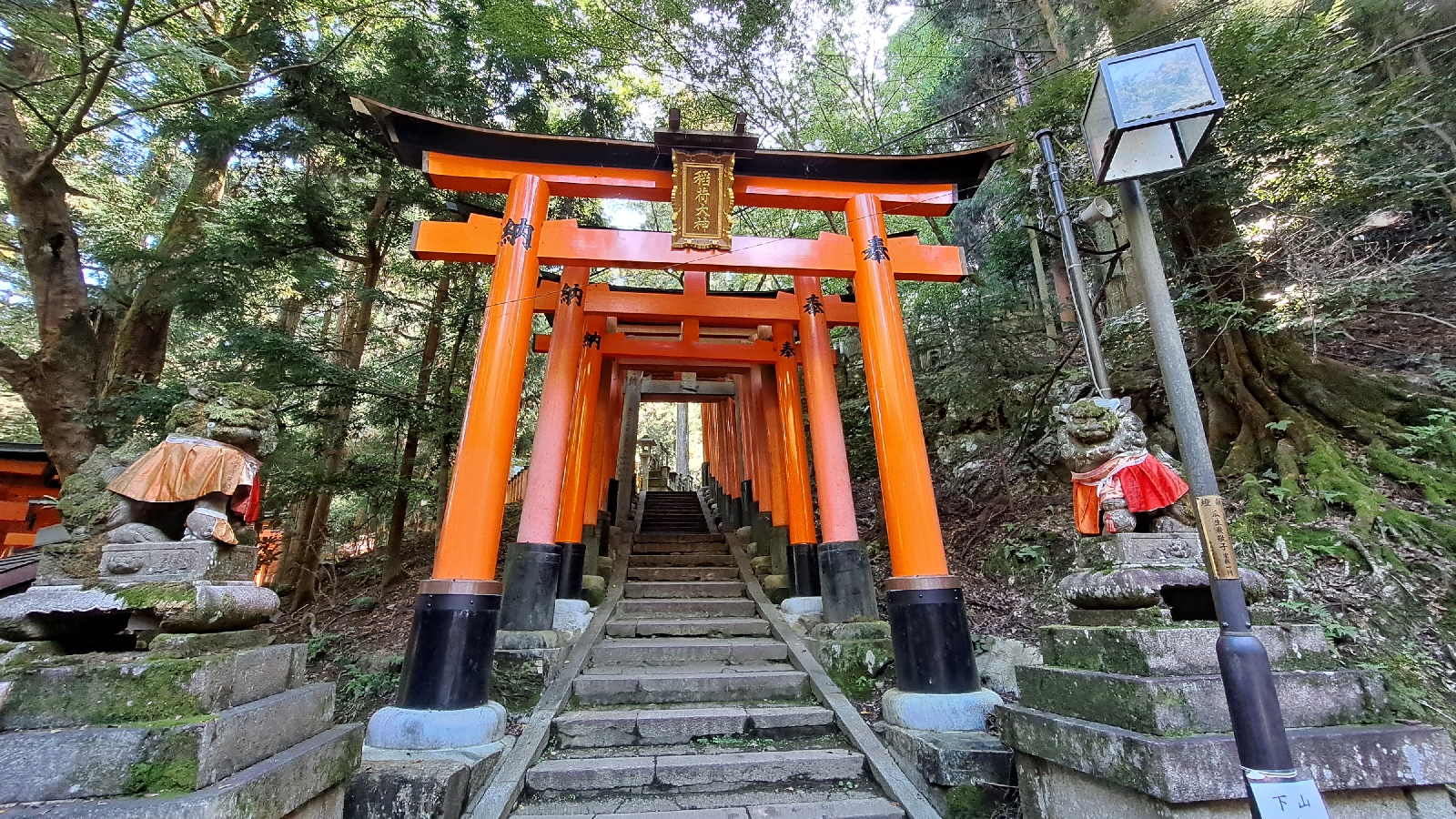
We have visited the Fushimi Inari Taisha, the Kiyomizu-dera and enjoyed walking along the Kamogawa, visiting the imperial Palace and the narrow streets packed with izakaya and karaoke bars.
This time, with no rush, we have been able to experience the city better.

Despite the obvious abundance of tourists, the city is more chill and relaxed than Tokyo, and sitting on the riverside is an amazing way of relaxing during a warm afternoon in October. Adding the nice bonus of practicing the shinobue in the shadow made us blend better with locals.


Once again, closing the day in the onsen close to the hostel was a magnificent way of relaxing our muscles after a day of walking. And Arashiyama at night, with no crowd on the streets, gives off a completely different vibe.

venerdì 22 febbraio 2019

Day 5: along the river from Kyoto to Nara

The light falling through the windows tells us that today we won't have rain. Gratified by this awareness, we consume our breakfast and sit on our bikes, riding along the Katsura river to reach our destination for the day: Nara.


The cycle path along the river is pleasant: away from the traffic, among the greenery and small gardens with just few deviations onto the main roads. It is also not too crowded: we meet a few students going to school and some elderly people doing some sport, but for the rest we are alone. However we meet a couple of cycle-tourists sharing the road with us, and we quickly realize we are close to the panoramic terrace on the Uji river, where we were 5 days ago.


We stop there for a short break and to buy something to drink, and we meet all the cyclists we have crossed earlier. We exchange a quick greeting, and then get back on the road, following the Kizu river. We are now in the Uji region, famous for the Uji-cha, a variety of green tea. And we see the first tea plantations along the river, together with the Kozuya bridge.


We stop to take some pictures and to cross the bridge, which can be done only by walking, as an old lady confirms when I question her. The bridge is made according to the old Japanese tradition: several boards which are not nailed to the wooden pillar, so that in case of flooding they can float away without destroying the bridge. Only some ropes ensure that the floating boards are not carried away by the flow.


The river is not full of water, and therefore it's not that impressive, but I can easily imagine how does it feel to cross it when the river is swollen.


From there it begins the most scenic part of our day: we cross large rice fields, where farmers are busy with the harvest, and the countryside is shining with golden reflexes all around. Large grasshoppers jumps across our path when we pass by their hiding places, and the kilometers literally fly without us noticing.


When we reach Kizu we stop for lunch: there should be a park around, but we are not able to find its entrance. Therefore, when close to a rice field we find a small altar dedicated to Jizo-sama, we politely bow and ask for its permission to have lunch there, leaving some sweets as offers.

Restored by the lunch, the usual onigiri, sandwiches and bananas, we proceed heading to Nara. We reach the Todai-ji entering from the Shoso-in, and there we take a look around.


But the fruit we have in our panniers is attracting too much attention from the deers wandering in the park, so we cannot leave our bikes unattended.


We reach Haruya-Naramachi, our lodging in Nara and we park our bikes there. The building is an ancient residence which has been converted into a guesthouse, and it surely perspire antiquity with its dark wooden beams and the tatami mats.


We change our clothes and head for the onsen nearby, just few minutes walking from there, called Asahi onsen.
I should have probably read more carefully the instructions at the entrance, because the first pool where I enter makes me feel shaking: it takes a while for me to realize that I have entered the section with electrified water!

While I move to the more normal sections (sparkling water, hot water, cold water) I hear a loud laughter coming from the women section. Among the chatter I recognize my travel mate's voice, mixed with the voices of unknown Japanese guests. Apparently, while I was left to discover the bath undisturbed in the male section, on the other side the customers guided her into learning the proper way of bathing (first cold bath, then hot bath) by dumping on her bushels full of cold water. 


From there we go out for dinner: we reach one of our favorite chains to eat in Japan, Tenkaippin and its thick, tasty chicken broth.
After eating a good bowl of ramen, a serving of gyoza and fried rice, with a good chilled beer, we walk back to the lodging, where we prepare for the night.


Today has been a really satisfying day, with a lot of fantastic sceneries and a wonderful weather. The fun is just starting!


martedì 19 febbraio 2019

Day 4: From the mountains to Kyoto

After a night of sound sleep, we wake up with the sound of the rain. We don't need to open the windows to understand it is raining, and we are glad our route for today is rather short, having only to reach Kyoto.


When we are having the fantastic breakfast served by Ryoso Chatani (all but the natto, we are not yet ready for it), we decide that we will take route 40 instead of highway 367 to reach Kyoto. Since it is smaller we are sure we will find less traffic on it, and considering the rainy weather this is something we surely want.

We wear our rain gears and get on the road: route 40 starts shortly after the place where we are, and quickly climb up the mountains. The vegetation is so thick it almost looks like the road is going to disappear soon, and when we reach the pass the rain has stopped. But since from now it is all downhill and we are sweaty from the climb, some additional covering doesn't hurt, so we leave our rain gears on.


We pass through small villages where again our presence tingles the curiosity of all the kids going to school, no matter if they are walking, cycling or sitting in the school bus. But the idyllic scenery is quickly over, as soon as we place our wheels in Kyoto.

Though there are always broad sidewalks where we can bike, the problems are given by the crowds of tourists: they step out from the buses noses in the sky and not giving a damn of where they are going and who might be in route of collision with them. With the panniers on the side of our bikes we cannot always zig-zag, and more often than not we have to stop and let the mass flow.


We therefore decide to reach our destination, leave the bikes and the panniers and walk around. When we are a couple of kilometers from our place, we have to pass over the railway, and we take a bridge which seems to serve our scope. We are not even halfway that a police car is behind us, asking to stop at the end of the bridge. When we do two policemen come out of the car and first ask for our passports and then why we took the bridge when it was forbidden to bicycles. We have clearly missed the sign on the other side, and we deeply apologize with them trying to explain what happened. They ask us some more questions then let us go.


After passing the Arashiyama bridge we reach Mulan Hostel, where we are lodged today. We are way earlier than the check in time, but the staff is really kind and let us in, allow us to change our clothes and park our panniers in the lobby even though the room is yet to be prepared.


We then walk out to visit the neighborhood, going first to Horinji temple. From there we search for our lunch, and after wandering around we find a promising place: it's called Arashiyama Curry, immediately South of Saga-Arashiyama station and we will find out that they make a really superb curry.


When we sit at the table we are the only two customers in the place, and notice they have a Mikan puppet on the counter. Upon asking them if they come from Ehime, they are pleased we have recognized Mikan, and explain us their relationship with that prefecture of Shikoku; I don't remember whether they are born there, or if their son is studying there.


While we eat our curries more customers come in, and when we are about to leave the place is pretty crowded.

From there we move to the Tenryuji temple and then to the bamboo groove. Walking through the high plants makes us really feel tiny, and we easily forget about the crowd present in the place.


We get back to the hostel to grab the towels and then reach the public bath: today we have decided to use the nearby onsen to relax. The place is really nice and not too crowded, and also the rest area at the exit of the bath is pleasant, with tatami floor, manga, newsapapers, tv and free drinks.

Regenerated by the warm bath, we buy our dinner and return to the hostel, where we sit in the dining room together with other guests while eating our food: traditional Japanese houses are nice, but also modern buildings like this one have their appeal and comfort.


We get back in our room, dive into the western style beds and quickly fall asleep.

domenica 17 febbraio 2019

Day 3: closing the loop around Lake Biwa and approaching Kyoto

A hand knocks on the fusuma, waking us up.

When we reach the living room, an old man wishes us a good morning, while busy in the kitchen preparing our breakfast. Still numb from the sleep, seeing him moving back and forth rapidly and precisely is like getting an injection of adrenaline.


Thin sliced salad with sesame dressing and tomatoes, scrambled eggs with sausages, Hōjicha:this is our breakfast today. While we consume it we discuss about our route for the day: we have read that the South-West side of lake Biwa is not that pleasant to bike, therefore we have decided to follow the coast for a while and then, via route 23, reach route 367 which goes in the valley between two mountain ranges. 

Though it is a highway we have seen that there are often side roads which should allow us escaping the traffic if we would feel the need. And then we will have the rain, so we want to ride us much as possible before it starts pouring.

Therefore we prepare our bikes, bid farewell to the landlord and hit the road. From the guest house to the lake side the distance is short, but when we reach it we have to stop to enjoy the scenery: a long row of trees, behind which the mist covered lake surface, flat like a mirror, unveils in the distance mountain ranges and cities.


We stop on the sand to take some pictures, and then move on. The magnificent landscape we have just seen has boosted our energy, and we move in the waking up villages with a good vibe.


When kids start to crowd the roads going to school, attracting their attention is unavoidable. Two of them, more daring, ride next to us on their white bikes. The bravest of the two holds his courage and greets us with a "Herro!". When we answer with a smile and with an "Hello!" he goes a step further, asking us "Do you rike sushi?", to which we answer "Yes, also miso ramen!". This makes them laugh, and they wave their hands when they proceed to their school, where we are sure this small adventure they have lived will be the topic of the day.


Outside the villages the road is pretty much deserted: the only people we meet are workers busy repairing the shoulder here and there. When we reach Adogawa and take route 23, the landscape quickly changes. 


Though the road is not extremely steep, the landscape quickly turn mountainous, with tall conifers, continuous zig-zag and a drop of the temperature. When we reach Takara Bokujo I stop at a gas station to inflate the tires of my bike. I gesture toward the clerk that the tire is deflated, and he asks me to give him the pump of the bike. Quite puzzled I hand it to him, and when he tries to use it, I ask him if he as a compressor. He then takes a tank of compressed air and inflates the tire. Talk about spirit of service!


For a good part of the 367 the traffic is never too heavy, and we can enjoy the surrounding. We take a break at a combini, where we are greeted by a couple of bikers who are also taking a break. Then a curious old man comes close, asking us where do we come from and where we are going. Considering that ahead we are not sure to find other shops, we also buy our lunch.

Shortly after we are back on the saddle it starts raining: first in a gentle and seamless manner, then heavily. Because of the rain we don't stop at any of the temples along the itinerary: they are not visible along the road, and we don't want to get lost in the woods under the rain.


At a certain point we find the side road departing from the highway, and we take it. When it goes under the highway we stop under the bridge and decide to have lunch there: there is no traffic, the Keishoji temple is somewhere in the forest but not easy to reach and we want some rest.

While hearing the pouring of the rain from the sky and the roaring of the river below, we study the road ahead. Soon after the pass we should be able to go around the highway by riding through the village grown around it. 


Finished our onigiri we get back on the bikes, but after a short while we have to stop: the road is flooded by the river with trees and rocks blocking it. Probably a souvenir of the typhoon, low in the priority list of the recovery intervention. 

Back on the highway, then we reach the pass and descend the 4 hairpins: the view is fantastic, but the road is really wet and we don't want to fly below, therefore we have to pay the utmost attention to where we put our wheels and cannot really enjoy it.

Once in the village we have to climb a steep road before getting back on the highway, then we finally manage to enter the road which, after a few kilometers, will take us to our lodging. It proceeds on the mountain side, through houses which are mostly abandoned.

When we finally reach Ryoso Chatani it is still raining, and after having parked our bikes in the garage, we ask the staff some old newspaper to wipe dry our bags and clothes before entering our room. Then we soak in the ofuro, before heading out to buy our dinner. 


The rain is gone, and the countryside where we walk in the dark is filled by the noise of the frogs. Out in the distance after the mountains the lights of Kyoto shine on the clouds. Tomorrow we will be there.