Visualizzazione post con etichetta Kansai. Mostra tutti i post

lunedì 10 giugno 2019

Day 17: back to Osaka.

The bad weather we had yesterday is gone, and today the sun will shine, according to the weather forecasts. However when we leave the hotel the sky is still gray.

We have decided that we will reach Osaka not from the North, along the rivers Kizu and Yodo, but first going West and then, after the pass, going North. First we reach road 105 in Kashihara and then start following it. While we are on it, we notice a suggested cycle route, and we immediately deviate on it.

It goes in our same direction, but hops from temple to temple along canals and trees, way better than a busy city road. All the three temples we visit are practically deserted, except the last one, where an old woman is praying when we arrive cycling through the high grass growing in the back of the temple. Finding the entrance is not immediate, since the cycle path has a small detour leading into the precinct, and it goes hopping above the small moat surrounding it.

As a pleasant intermezzo, while we are in the parking lot of a combini, we see a white mini car with a car on its dashboard, busy fighting a fierce battle against a fly, while its driver is inside the shop to buy something.


We stop for lunch in the park along the Yamato river where, while we are eating our onigiri, a couple of youngsters are practicing sprinting.


From there we take route 25 to reach Osaka. Apart from a bridge over the railway which is forbidden to bikes and that we take extra care to avoid, the road is not that bad as it might look on the map. There is not too much traffic, the lane are spacious enough that the traffic can avoid squeezing us on the side and also the slope is not bad.

We discount it when we reach the crossing between the 25 and the 165: we manage to take the right path on the pedestrian walking only at the second attempt, and after a loop that takes us back to were we starting from!

After a short section next on the bank of Yamato river, we head North on the 170: for a good length it is a pretty anonymous, semi-rural road, not too crowded but also not that panoramic, though on our right side we have the hills bordering Osaka. At a certain moment we reach a very large building, which we learn is a recently built temple.


It doesn't have the vibe of an old temple, but it surely stands out in the neighborhood.
Immediately after a rail crossing, the road turns into a commercial road: pedestrians all around, shops and their goods on the sidewalk, music coming out from the speakers. And as suddenly as it appeared, as suddenly it vanishes, returning back to the road we were on before.


At the end of our route on the 170 we pay visit to the 2600 years old Ishikiri Tsurugiya Shrine. After a short climb, we reach the road were the temple stands, surrounded by small shops selling sweets, amulets and where fortune tellers make their days with the money of the visitors.


The temple is a refreshing variation to the menu of the day, and we indulge in the visit for quite some time. The place is really relaxing, and the buildings are really impressive.


After leaving the temple we head West: on a straight line we should end up to the castle, and from there to the shop to return our bikes. The surroundings are all but fascinating: the road is packed with traffic and has no decent shoulder nor sidewalk for us, so we try, as much as possible, to zig zag in the neighborhood on the banks of the Daini Neya river, which however are full of small industries. We rush just to get out of it as soon as possible.


Nevertheless we manage to reach the pedestrian bridge on the O river (which Google maps hides), where we have started our trip 17 days ago. A quick stop at Tenma Itoya , the same guest house where we have slept at the beginning and where we leave our panniers, and then to Globalwheels to return our bikes.


We exchange some impressions about our trip with Gareth, change our shoes and walk back to the guest house, where we can finally take a relaxing shower before going out for dinner.

The tenant is happy to see two returning guests, and considering how nice was our stay the other time, we really had no reason to not return here.


We have our dinner at a tonkatsu restaurant not too far from the guest house. On the way back to the lodging, we savor the satisfaction of having completed the trip.

domenica 2 giugno 2019

Day 16: rain and a sleeping bear.

When we went to bed yesterday we already knew that today would have been a rainy day. Therefore our main intention is to chew as many kilometers as possible before the road, and us on it, gets wet. We will use, for most of our route today, the cycle route 1, which we have already used when we have reached Hashimoto from Nara and starts exactly here in Wakayama.

The only little problem is that it starts on the sea side, while we are already in the city, therefore we head North for the shortest path to the route, which lays on the North bank of the Kunokawa river, hoping that whoever designed it had in mind that not necessarily everyone uses it from its start.

Once we pass the bridge on the Kunokawa our hopes are crushed: we see the cycle route 1, but there are metallic fences everywhere, and the only two options seems to be either zigzagging in the neighborhood or, like most of the students do, using in the wrong direction the one way road packed with cars. Neither of the two seems appealing, and at a closer inspection we find prove of the Japanese flexibility: someone has placed a metallic ladder to help cross the fences!


I take the two bikes across, and we finally can freely cycle! We cycle for about half an hour when it starts raining: luckily we are taking a break at a combini to use the toilets, therefore we have the time to wear the rain gear without getting wet. And then we move on. The wet path is practically only for us, we seldomly meet someone, and when we do is usually some old man trying to fish in the river. Only when the cycle route merges with the main road we meet some car driver.


Along the road we find a service station, and we stop to buy something to drink and get some rest from the rain. The same idea has occurred to several motorcyclist who are parking their vehicles next to ours. None of them can avoid a surprised face upon seeing the two blue bikes and the two bright yellow dressed cyclist next to them.

After the break we immediately get on the saddles and move on. Once we reach Hashimoto the road is known, but this time we won't take the route in the mountains via Yodo, but will proceed along route 24. Few kilometers after the Yoshino river, which this time is less flabbergasting due to the gray sky, we stop for lunch at a combini.


From there we continue on a slow and steady rising slope, but at least it stops raining. In one of the cities we cross, some students are cleaning the road, and as soon as they see us we become, as to be expected, their main attraction.

After Gose we leave the main road on proceed on the small roads next to it: it's a blessed choice, as we get to see nicer landscapes and less cars. We cycle along a small canal surrounded by cherry trees, which in the right season must a mindblowing view.


Before heading to our hotel, we take a deviation South, to visit the mausoleum of Emperor Suizei and Emperor Jimmu. The rush hour for the visitors is already gone, and there are few people in the temple. The most noticeable is a little girl in a kimono, who was probably involved in some religious ceremony: she is running around laughing and shouting, and just stays quite for a moment upon seeing us. Then, once assessed that those two yellow creatures are not dangerous, she continues in her playful activity.


We continue our visit to the mausoleum: the precinct is really large, but what strikes most is its emptiness, even for the Japanese standards. Just pebbles, nothing else, covering the area comprised among the buildings.


There is also a small pond next to it, but we see nothing attractive in it, and we get back to the main building.
Accompanied by the sound of our shoes on the pebbles, we slowly reach the exit, where our bikes are parked next to guardian building. We thank the man working it for having taken good care of our bikes and move toward the hotel.


When we reach the Yamato Kashihara City Hotel we find a normal multi-story building, where we park our bikes in the back, under a ladder. But the room is tidy and decent, and after a day under the rain this is more than enough for us.

After a refreshing shower we decide to have our dinner at Burger Craftsman. The place is at walking distance from the hotel, and for a change it is not traditional Japanese food.


From the outside our attention is captured by the large teddy bear sleeping on an hammock next to the entrance, and once inside we get a delicious hamburger and a double serving of beer.


On the way back to the hotel we stop in a shopping mall, just to give a look around. We are the only two non salary men in the premises, and surely also those with the most relaxed face.
From there we go to our usual combini for the traditional good night ice cream, and then to the hotel.

Tomorrow we return to Osaka!


venerdì 10 maggio 2019

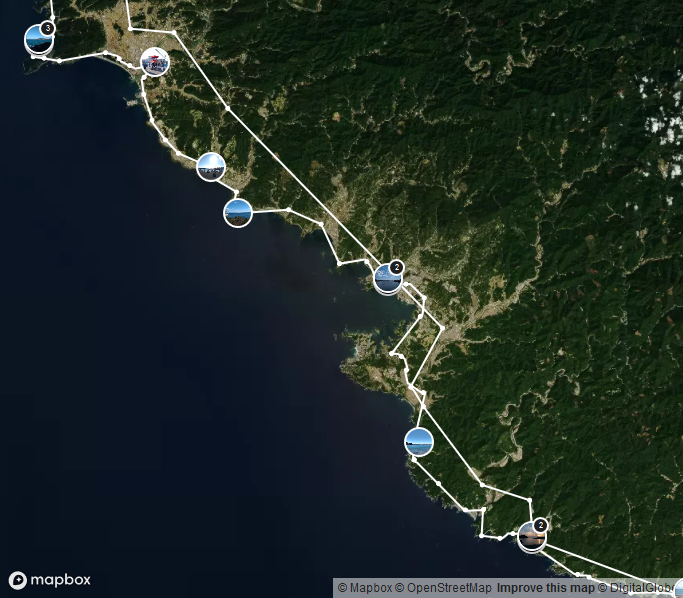
Day 13: the oceanside from Susami to Gobo

With still in the eyes the sunset we have seen yesterday, when we look outside the window of our room in the morning we are blinded by the clear sky and the light already flooding the coast. Today we will reach Gobo and will try, as much as possible, to take the small roads siding route 42.


The first chance to do it comes immediatly out of Susami, where the main road goes through two tunnels while the side road we take goes (and climb) around the cliff, giving us a good view on the sea and also an early warm up for our legs. From the cliffs the view on the ocean is wonderful, and the clear sky makes the water look dark blue, with just some waves in the distance breaking the color with touches of white.


Further on we are forced to rejoin route 42, and when we reach Tsubaki we see that the city has a lot of natural hot springs on the coast. Too bad that, so early in the morning, there is no way to use them. As very partial compensation, we use the post office to withdraw some cash. Then we reach Shirahama, were our plan would be to visit Toretore village, a place famous for having panda shaped houses. But we don't know that the place is a residence and it's not open to public visits, as the gatekeeper explains us with a grumpy face when he stops us. Shortly after moving away from there, when we are stopping at a vending machine to buy something to drink, a group of motorcyclists greets us with great enthusiasm.

We stop for lunch in a park next to a temple, where, together with us, there are a couple of moms playing with their kids, and a group of elderly people talking among themselves. As soon as we park our bikes, two of them begin examining them, judging the gears, the panniers, the saddle and all the equipment, then they decide that is time to inquiry us about our trip. Once received the needed information, they start over discussing among them.
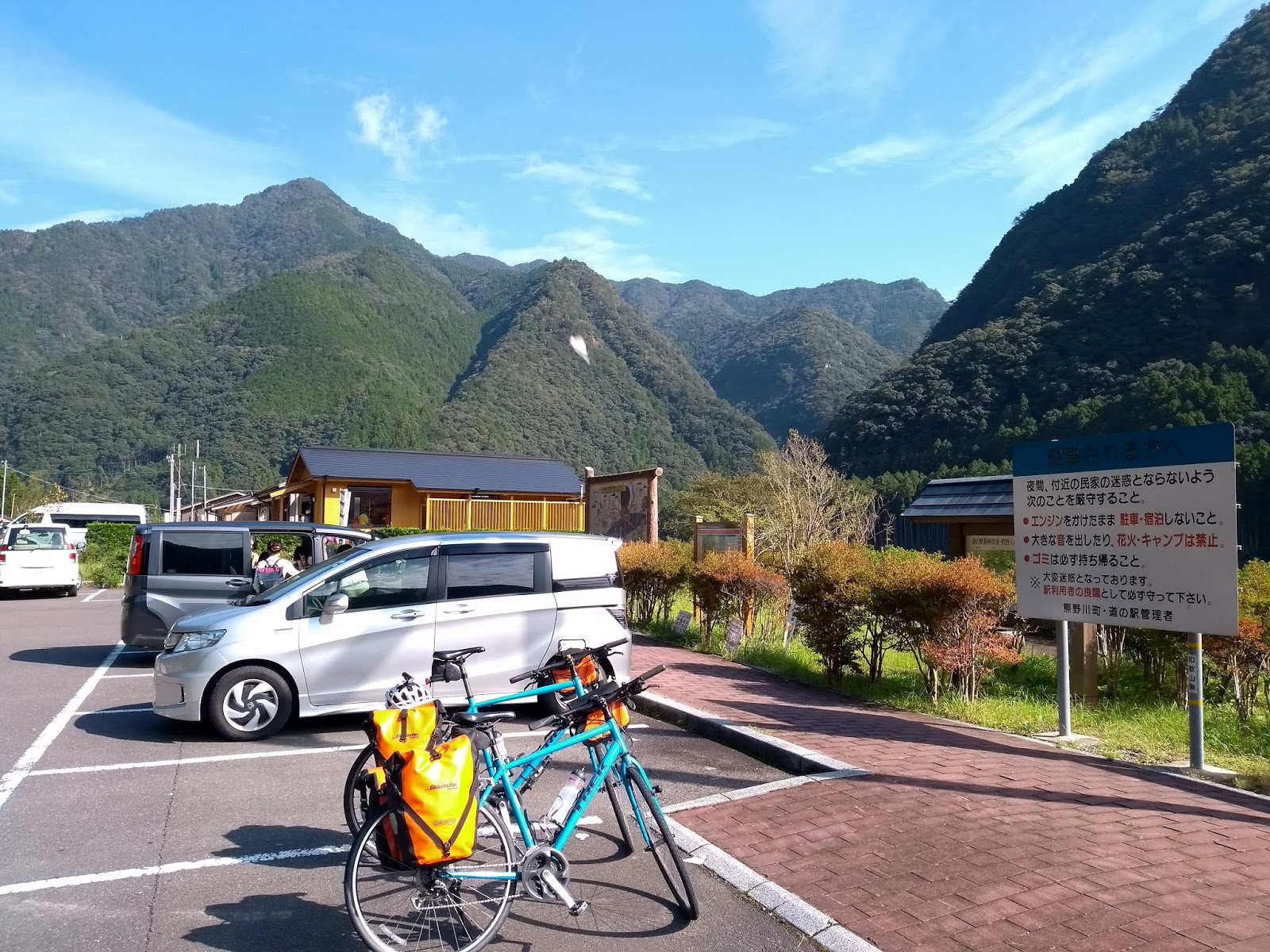

After our lunch break we have to move on, and we climb again on the cliffs, where the road goes parallel to the coast. We stop in a service station to have an ice cream, much needed considered the hot temperature, and there we are greeted once again by another group of motorcyclists. They ask us about our trip, and to me this is quite surprising: I am used to motorcyclists looking down on their motorless cousins 😄.


When we descend again around sea level we are almost in Gobo, and we are welcomed by a small traffic jam, due to a car accident on the road. We go around it and rapidly reach our destination: Gobo Forest Inn.

It's a business hotel, so we do not expect anything excessively fancy. However, to our disappointment, they have a male only onsen (so, if you are a woman, settle down for a shower), and when we ask them if we can fill our bottles with water from the dispenser, they answer with a "Yes, but just a little". But at least they have a restaurant where we can have a good dinner, so we just take the good things, preparing for the next day.


mercoledì 24 aprile 2019

Day 12: the hawks soaring on the Ocean

Yesterday we fell asleep listening to the practicing choir, and today we wake up with the city speakers diffusing something which we are not able to understand, but it sounds like a female voice singing some public service announcement.

While we enjoy our breakfast and savor some of the dishes prepared by the landlady (she is a really skilled cook), we try to plan our route, as usual. We have to options: we will start on the coast until Kushimoto, and then from there we can either continue on the coast until Susami on route 42, or go inland though the mountains and reach Susami through routes 371 and 38. The latter is about 20 km longer and has, necessarily, more climbs, but on the map it looks less subject to traffic. We have a preference for the coastal route, but we will take the final decision after Kushimoto.


We greet the landlady and start moving: there is no bike lane and we have to take our space between the concrete barrier on our left and a steady flow of trucks and cars on our right: from time to time, when the shoulder is broad enough to let us cycle there it's refreshing. However the sight on the Ocean is amazing: the sky is deep blue and the water reflects this color, together with the bright light of the sun. When we reach the Hashiguiiwa Rocks the view is astounding, and we are not the only ones to enjoy it: the parking lot is full of cars and bus, with people searching for a spot to take pictures.


From there we see the bridge taking to Kii Oshima, which we want to reach immediately afterwards. We reach the ramp leading to the bridge by crossing the harbor, and when we are on the bridge we are struck by the wind: until now we were protected by the orography of the place, but now, after the cape (and on this island protruding into the Ocean) we are just mercilessly exposed.

On top of that the road cuts across the island without too much attempts of mitigating the slopes, and so we have to take some dose of climbing to reach the Kushimoto Turkish memorial museum. According to the history, a Turkish vessel had a shipwreck on this coast at the end of XIX century, and the islanders helped the crew to reach safety. In memory of that a statue of Ataturk faces the Ocean, right next to the lighthouse, and some shops sell Turkish souvenirs, like carpets and water pipes.


When we are parking our bikes a group of students walks next to us, and one of their teacher asks me about our trip. I explain him that we are touring Kansai on our bikes, and he is really surprised when I tell him that we are using our entire 3 weeks vacation to do this trip: he thanks us for dedicating so much time to this region, and goes to his students to tell them what he has been told from us, and when they walk back to their bus, they all wave at our direction. We have become celebrities once again!


After this random meeting we climb on the lighthouse and enjoy the view on the Ocean: the waves continuously splash on the rocks at our feet, making the water white from the foam, while several hawks fly high in the sky, drifting in the strong wind that knows no obstacles here. In the distance several ships cross the sea, going somewhere under the bright sun. This place during a storm might be surely terrific!


We take some pictures and then get back on the road: we have to face again the climbs we have met coming here, and the sun has become hotter. We decide that we will take the coast route, preferring the shortest path, but we soon kind of regret it: until we reach Esumi, where the expressway starts, the traffic grows bigger, and the cycling lane, when present, has the unappealing feature of being on the right side of the road and, if that wasn't already enough, whoever designed it decide that it is fine to stop it in the middle of curve when the road is rising. For sure we don't want to bet our lives with such a crossing, and we keep our left side of the road.


We stop for lunch at a marine park, where we find some benches were we can sit. Having more time we could also visit the underwater tower, allowing to see the bay. After the expressway the traffic practically disappears, and we can enjoy the view and the head wind blowing on our faces. The views on the Ocean are, once again, stunning, and from the time to time we see boars or deer peeking through the bushes on the hills on our right.

We reach Susami in the afternoon, about one hour before sunset: Sunset Hotel is well equipped for cyclists (it has bike racks in the main all for those who want to park their bike overnight) and, being located on the harbor, offers a fantastic view on the setting sun, as its name suggests.


We run to the supermarket to buy some food for dinner and then stay in harbor to enjoy the falling night. Then we take a relaxing bath in the onsen and have dinner in our room. All in all we are glad we have taken the coastal route: we didn't have to rush to avoid the darkness, and the road was pleasant after the expressway. We are just left with the curiosity on how would the other path might have been.


domenica 14 aprile 2019

Day 11: the shining blue of the ocean side

Part of our route today will be the same that we have done yesterday, therefore we are looking for alternatives. We have seen that there is another road on the other side of the river, and we ask to the owner of the hotel about it. He tells us that route 740 is not a nice road, being too narrow when compared to route 168, but that is music for our ears: it means that there will be less or no cars!

Finished our breakfast we greet the hotel owner and his family and we set in motion: the air is chilly and the road goes downhill, and as much as possible we want to be on the main road before the traffic of the morning. Indeed, apart some bus full of students going to school, we meet no annoyance on the road until the point we can cross the river and reach route 740.


Indeed it is really narrow: if we should meet a car, we would have to step down and stay on the side to let it pass, but there is no sign of people using it, and moreover it is also being serviced, so we are confident we will be alone for a while. For a good while the road moves across the trees, letting us see the river on our right just for few moments, but then it opens up and allow us to enjoy the mist covered valley where the river flows.


Often we see small waterfalls, either on our side or on the opposite side of the river, which give a fantastic vibe to the place. The frequent pauses to take pictures allow also the sun to rise and shine some more light into the valley, increasing our delight.


This narrow road is a true blessing, and cycling on it is really funny: aside from the gorgeous scenery given by the forest and the river, it has constant ups, downs and turns which keep the eyes and the body alert and active.

At a certain point the forest opens up and we notice a flat area on the left, with what looks like a wooden building and a parking area. When we get closer we are welcomed by the magnificent Hisetsuno fall, rumbling down from a cliff. The wooden building is a camping ground with shop and barbecue, which, considering the early time, is of course empty. But for us it is fantastic: we park our bikes and take some pictures, enjoying the sun warming our bodies and the sound of the waterfall in the distance.


After the break we cross a small village and after it we see the island where the matsuri was held the other day: we are in Shingu, and from there we quickly reach the coast, from where, on a known road, we reach Nachi. Along the way a fisherman we meet in Miwasaki seems quite amused by the sight of two foreign cyclists. The same impression seems to have an elementary school class, which we meet while withdrawing some cash from the post office.


We stop for lunch in the sunny bay of Ugui, where we find a nice beach with benches right in front of the sea. From there we continue until we reach Nachikatsuura and its fish market. The main market is closed, but the tuna we see on sale in a supermarket looks really tasty.

When we reach Koza we have still some time before sunset, so we decide to go inland to visit the pitted rocks of Kozagawa before reaching our lodging.


The place is called Yamasakiya and is run by an energy full old lady, with a strong passion for cooking. Despite not having requested the dinner, she offers us some samples of her skills. We are  delighted by the delicious food she prepares, but also regret not having the full dinner there.


The room upstairs is really big, and while we relax in it, we hear someone singing close-by. When we give a look outside, we see that in the building opposite from our room, an old school, a choir is practicing. Their voices are the only human sound which we hear in the otherwise sleepy town.

mercoledì 27 marzo 2019

Day 10: Hongu, climbing into the hearth of Japan

After a good night of sleep we are welcomed in the kitchen by Seiko-san and the breakfast she has prepared for us. She insists that we eat plenty of food, since we have to bike the entire day, and who are we to disappoint her? It's really a pleasure to have some chat in the morning, and Seiko-san is a really good host.

Before departing we take some pictures together and then the two of us hit the road on our bikes. Being early in the morning there is not so much traffic, and we manage to exit the town with not that much effort. Then the highway 311 starts climbing following the Kumano river, with just trees all around us. The temperature is chilly due to the lack of direct sunlight, but pedaling uphill makes it pleasant.


After few kilometers of steady progress we get a small inconvenient: a flat tire! Luckily we are close to a lay-by, and we can stay off the road while fixing it. While replacing the inner tube the frequent moments in which no car is driving by let us enjoy the quiet of the forest: walking these mountains must be a real pleasure.


Fixed the tire we resume our climb, and some more kilometers uphill we find, on our right, a rest station, where we stop to take some picture and buy some drink. Down in the river we see people doing rafting, while enjoying the sun on the benches together with us there are many who are either walking up the mountains or getting there by car.


Further uphill we see on our left side some waterfalls, but we have no safe space to stop our bikes and take some picture, and we just savor them with our eyes. In the blue sky several eagles fly around, searching for their prey. Before the electric power plant in Shikiya we have to exit the highway to avoid a long tunnel forbidden to bikes, and since we are there we also cross the bridge to reach the other side, which looks like more pleasant.


Our intuition is indeed correct, and we bike on a deserted road until we are forced to cross back on the main road, just before entering Hongu. There we reach the bus station to lock our bikes and, after having eaten something, visit the city.


First we walk to the huge Otorii leading to the Oyunohara: torii are usually impressive on their own, but this one, with his enormous size is definitely in another league, and seems really asking for respect to anyone walking under it. The inside of the shrine is quite and, surprisingly, not crowded at all: just few people praying, and a quiet atmosphere. Close to the shrine we spot again the French crew we meet before reaching Asuka few days ago. Also here they are busy filming the rice fields.

Returning from there we climb the stairs leading to the Kumano Hongu Taisha shrine, and here we see that there are more people, but definitely absorbed in spiritual activities. Some of them also consult the oracle and its future telling sticks, searching for a good omen.


We get back to our bikes and, before setting in motion again, we do a quick check to confirm that there are no open restaurants for dinner in town, so we will have dinner at our hotel. Then we move on to reach Ashita no mori.

The place is built in a small village next to the Oto river, and when we arrive it gives mixed feelings: some buildings are obviously inhabited, but some others look like they are about to collapse. Upon checking in we learn that what we have seen is the result of the typhoon: the swollen river has flooded some of the houses, and those which were not built higher than the road level have suffered large damages.


The owner explain us that we can use the outdoor onsen, bathing in the river, or use the indoor one, using the same spring. When we opt for the indoor onsen we are just warned that the water is really hot, so it is not advisable to jump in it, but rather slowly enter it to get used.

And I must say the water is really hot: at first I can barely enter it until my calf and I have to get out, then above the knees and get out again, then to my belly and out again, and only at the end I can manage to sit into the pool with just my head pocking out.  But then I can fully relax and soak my body into the onsen.

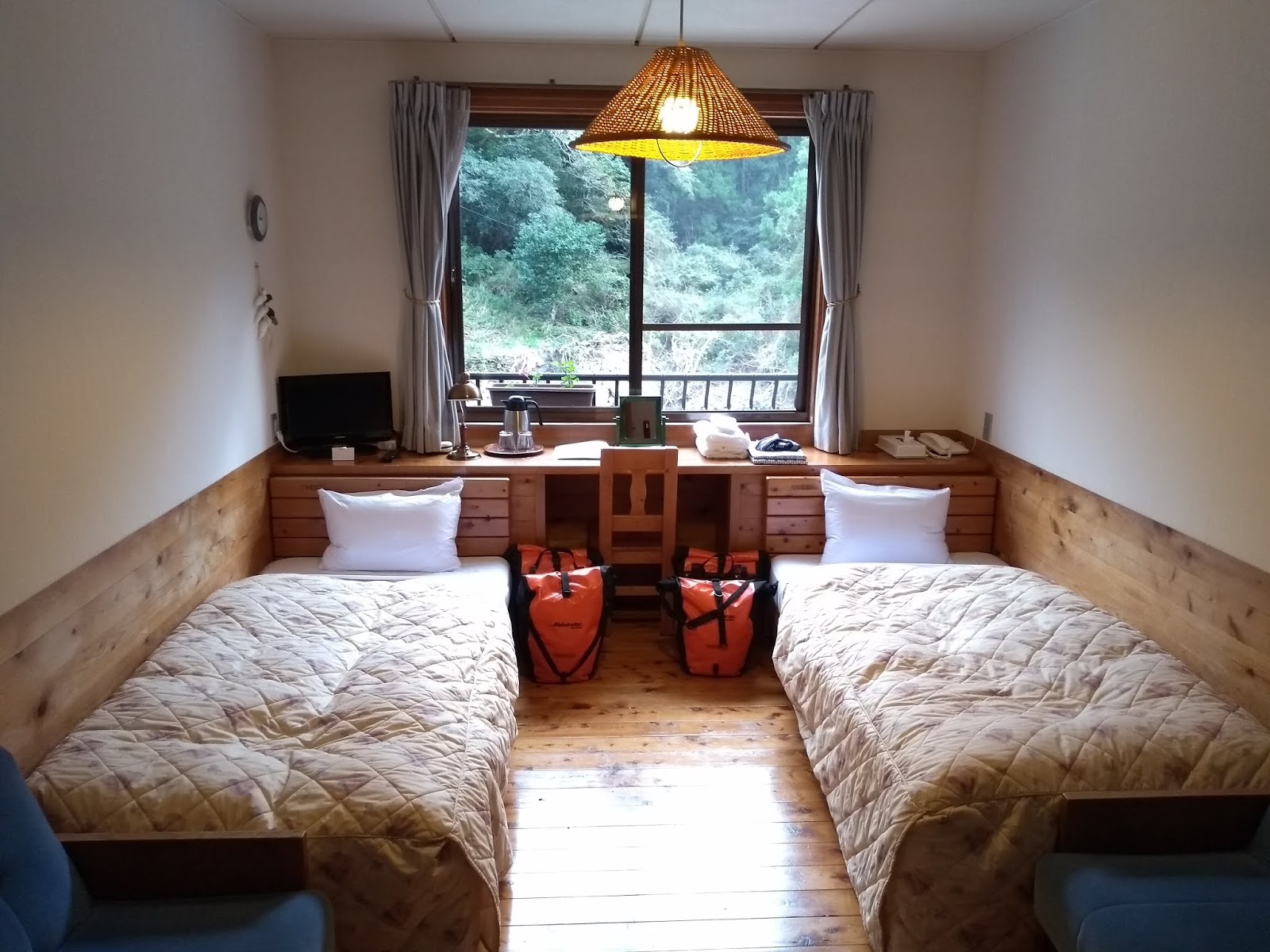
After the visit to the onsen we leave our panniers in our room: its interior is fully wooden, and it is a pleasant variation after so many days of tatami. Also the outside of the building stands out, with its alpine look.


When we get out for a stroll before dinner we see that some persons are bathing into the river, where it is clearly evident where the thermal water is springing out. Upstream a fisherman is laying his nets across the stream. We cross a small suspended bridge and reach an area from where it should be possible to reach the open air onsen, however the fallen trees cluttering the river bank advice us not to proceed further.


On the way back to the hotel we climb the stairs leading to a small shrine, where the divinity protecting Kawayu Onsen is enshrined. The murmuring waters of the river give a good feeling while we are here, and we enjoy the darkness falling on this remote place, before heading to the hotel for our dinner.

There we meet an old man, evidently the father of the person who welcomed us, as we can say from their close resemblance. He thanks us with a gentle smile for staying at their hotel, and gifts us two origami made from his wife.


Later we will discover that this very old man has a rich story behind: he left his job in the city and came back to the village where he was born to become a sort of guardian of the forest, taking care of the trees and trying to revive the local community. When we learn about this, all of a sudden the name of the hotel makes perfectly sense: Ashita no mori means "the forest of tomorrow". You can see his full story in the following video.


When we retire in our room we can clearly hear, through our windows, the river flowing nearby. Its gentle voice cuddle us in a restoring sleep.