The nice ending of yesterday evening has left a good sensation into our minds, and we have a positive feeling for today. We have booked our lodging for two days in Matsuyama, therefore we know we don't have to worry about the booking for at least one day.
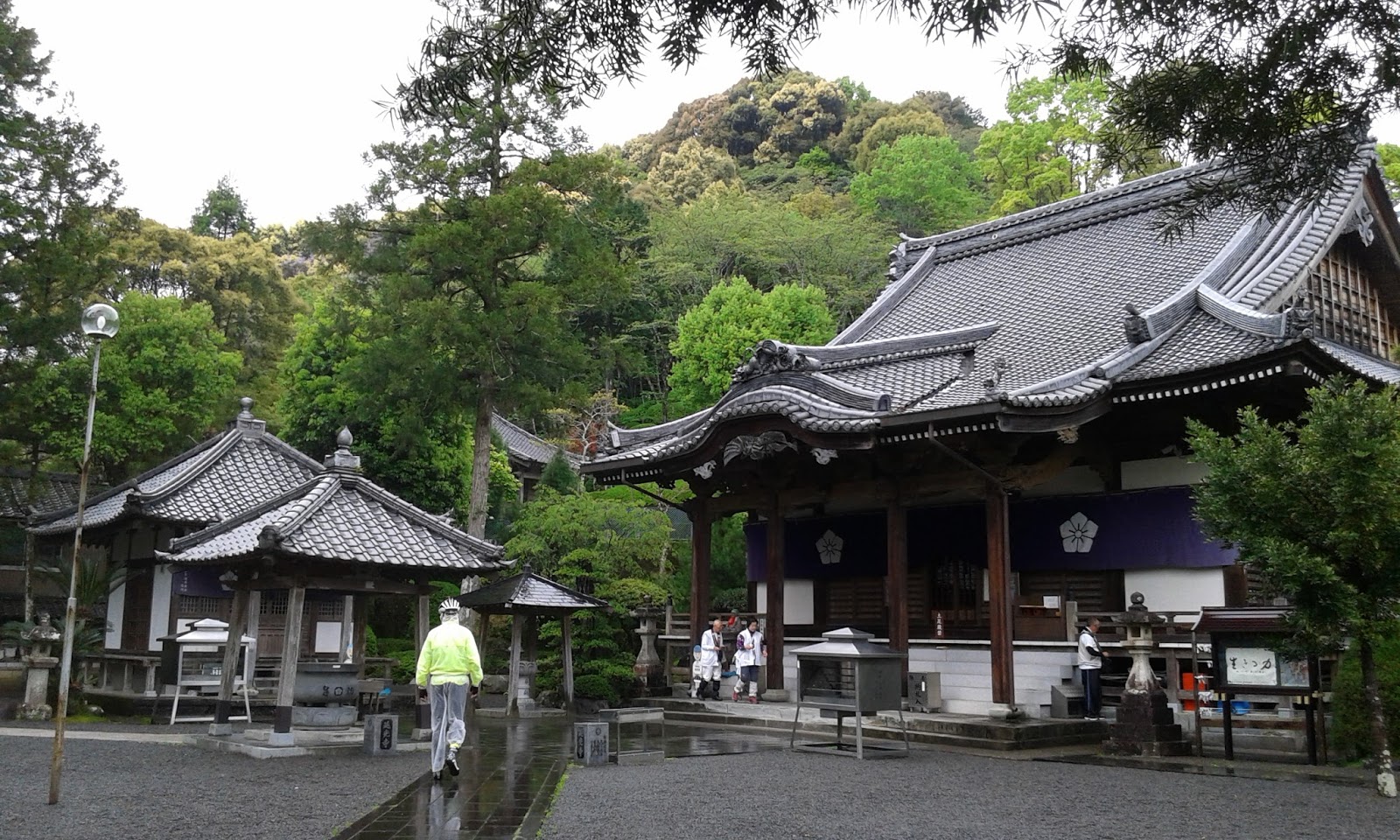
When we leave the hotel we are surrounded by a light mist, and the visit to temple 43 gets a more mystical vibe. We then get back on the road and take the climb until the Tosaka tunnel, cycling between tall trees half hidden in the mist.
After the tunnel we'll descend to Ozu city , but first we have to cross it with its 1100 meters and no sidewalk from our side. While we are busy in it, we are involuntary witness of what an excessive politeness on the road can bring: a driver trying to overtake us goes completely into the opposite lane (good, as we won't have to worry about the wind caused by the fast car) but in making so forgets to check for any incoming traffic, which in this particular case is a truck loaded with logs.
The result is a loud horn playing in tunnel right in front of us, which continues well after the two vehicles have crossed. Since we are the only with the head unprotected from a layer of metal and glass we are also those who suffer the most from the noise, and as soon as we exit the tunnel we have to stop and catch some breath.
We then descend to the city, and for a short moment we think we might have taken a wrong turn somewhere: a Gothic style building, looking a bit German-ish, is right in front of us.
Reassured by the kanjii signs, we recover from the cultural shock and proceed into the town. After spotting some walking henro we take a deviation which will bring us first in a valley following a river and from that on the coast.
The valley is gorgeously green, cluttered with farms and cultivated fields, with a railway running next to the road. We greet the farmers busy working on their land, and from their greeting back we have the feeling that it doesn't happen often that two gaijin venture in this area.
When we stop for a moment to drink some water, an old woman gets close to us. We greet her, and she greets us back with a shiny smile on her face, carved by the signs of countless summers spent working on the farmland.
She asks us where do we come from, and when we tell her that we are two Italian henroes and that we are cycling, she shows a big surprise on her face. Then she starts looking at our bikes, and is really curious about the cleats. We explain her how they work, and she is a continuous source of wonder exclamations.
She then looks at us and, mimicking the effort of pedaling, incite us with a "Fighto fighto!" while displaying her most happy smile which looks like the one of a young girl. We thank her for the nice words, and, amazed by her vitality, bid her farewell, while she keeps waving with her hands at us as we get farther along the river.
In case you are wondering, yes, she spoke only Japanese and we only English, but we both managed to understand each other!
Shortly after we reach the sea, and there we cross a small village with its harbor packed with fishing boats. Out of the village we spot, on the road, the blue line indicating the designated cycle routes: we have found a panoramic route which will take us until Matsuyama!
The vivid color of the sea water is simply amazing, here and there we see seaweeds harvested and put to dry under the warm sun of today.
The sight is so stunning that I find myself literally flying on the bike, while my travel mate has to shout to make me slow down.
We stop for lunch in a beach whose white sand is almost blinding, where there is a fair amount of people enjoying the sunny day: mostly cyclists, but also students who fill the air with their laughter while taking silly photos next to sea, and families relaxing with this nice view.
The place has also a restaurant which can prepare fresh fish on demand, but we don't feel like sitting inside with such a glorious day, and we take our place on a bench next to the beach and have our lunch.
Leaving from such a beautiful place requires a strong exercise of will power, but we cannot camp on this beach. After a short climb to a pass separating the sea from the city, we reach the outskirts of Matsuyama.
Getting used again to the traffic of the rush our is not really pleasant, but we treasure the road we have done so far, and keep going on.
Once we reach our lodging we find out that we will have it entirely at our disposal for both days: it is really an unexpected fortune. Not that we dislike having other people around, but being able to live in a traditional Japanese house alone is a new experience for us.
After getting a shower we reach the castle, few minutes after the ropeway taking to it has closed. We have no choice but walking the stairway bringing on top of the hill, and there we sit enjoying the view on the city while the Sun slowly sets.
There are only few other people there, mostly busy taking pictures of the blood painted sky while our eyes wander around the horizon, hopping from fishing boats to landing airplanes and the first dim stars appearing in the sky.
After walking down we go searching for a place where we can have dinner: we pick a small and almost deserted place where we have some Hiroshima style yakisoba.
We then walk back to the lodging, longing for some rest on the futon. The busy city center is just some buzzing sound far away from our room, and our eyes quickly close.
Where we slept:
Matsuyama, henro house Heiwadorii, via henrohouse.jp
mercoledì 28 marzo 2018
lunedì 26 marzo 2018
Day 12: Where we get motivation from a crow
Waking up the morning after a relatively easy day gives a good feeling of having more energies, and when on top of this we see the bright light of the Sun peeking through the windows we get in the right spirit for the day.
When we leave the hotel it's too early for the staff to be there, so we leave the key of our room in a basket left for that purpose and get downstairs into the parking lot. We fold our rain suits hoping to not have to use them any more, then get into the city roads.
With the correct amount of light even the city that yesterday looked so dull has a different aspect, and when we spot a couple of walking henroes getting on the road we catch in their eyes and in their smiles our same feeling. We quickly get on road 56 and follow it while it goes along the Sasagawa river.
Then a short climb takes us to the Ipponmatsu tunnel: we have reached Ehime prefecture! We quickly find that its fame as cycle friendly prefecture is well deserved: at our firs stop we find a rest hut well equipped for assisting cyclists, with pumps and all the necessary for small mechanical repairs made available. Continuing on the road we complete the first inland part of our day and finally reach temple 40.
After it we get to cycle next to the sea: the sun shining on the pearl farming grounds scattered in the countless bays is really a gorgeous sight, and the small villages developing next to them give a calm feeling. We could be in Mishima's The sound of waves, if we were on small island!
Continuing on the road we have also feel privileged to have a tunnel built just for cyclists and walkers next to the main road. The air inside feels rather chilly when entering it directly from the sunny road, but it's not so long that we really get cold.
Further on the road, when it moves back inland, we find a really nice rest hut, where we stop for lunch. It is not too close to the road so it is not noisy, and it is pretty large and comfy. We take some pictures and send them to the camping henroes we have met along the way, as it might be a good place to spend the night.
We stay on the 56, which becomes less used as soon as we meet the beginning of Expressway 56: we find way less cars using it, and what it remains are mainly trucks carrying woods or fruits.
After a while the road starts to rise, and it becomes a never ending series of steep tunnels, where the noise of the trucks passing by becomes loud and scary.
Adding the effort for the climb on a 12% slope to the claustrophobic feeling of the tunnels and to the strong noise of the truck we get a perfect mix of stressing factor, and we have to stop often to recover. Before the last but three tunnel my travel mate is about to break down in panic, and though we stop in a now closed service station with a magnificent view on the sea, surrounded by orchards growing on the steep sides of the mountains, we seem unable to proceed further.
When I am trying to find a way to get out of this situation, our attention is captured by a peculiar show: few tenths of meter ahead of us a crow is lifting a dropping a red thing (we will later see it is a dead weasel). We quickly realize it is trying to carry it across the road, being too heavy to simply transport it by flying.
The risk the crow is taking is pretty high: cars and trucks are not going to slow down for it, and at any moment can simply drive over its dinner and mash it. Nevertheless the crow keeps trying and trying, and when it finally reaches the other side of the road, dropping its load onto the side of the mountain, we cannot avoid celebrating for it.
I then say out loud: "if the crow was able to carry that load across the road, why shouldn't we be able to reach the pass on this road and get to our hotel?". My intention was initially to joke about it, but it quickly turn out to be a pretty effective motivation speech, and we get back on the bikes and get rid of the remaining tunnels.
The descent to the town is a pleasant reward, and when we reach our hotel we feel determined to have dinner outside. The man at the reception desk looks funny as Addam's family Lurch, but for the hotel room is nice and spacious, and we first get a shower. When we go downstairs we get in the streets looking for some place to eat.
We see a group of three women talking between them, and we get close asking if they can recommend any place to eat. Considering that our Japanese is still at zero we can only tell names of dishes, like ramen, soba and katsudon, so they are already to be appreciated for trying to pay attention to these two funny gaijin.
They start talking between them, and then one of the three just tells us "chotto matte kudasai" and disappears. We know it means something like "wait one moment, please", but we don't get what's going on. We then see a small car getting close, and in the driver seat we see the woman: she has gone to the parking lot to take her car, and is now bringing us to a restaurant. She apologizes for the small car (being 194 cm I fell a bit cramped in it, but I can only be grateful for what she is doing) and along the way we try to tell her something about us, while she tells us that she has already completed the Ohenro-san more than once.
She drops us at a restaurant, the same chain were we had dinner with Truss and Suzanne, and wishes us a good dinner and a nice stay, while explaining us how to get back to the hotel. We regret not having with us some osettai to give her, so we only bow and thank her for the exquisite gesture.
We then have our dinner, and then we enjoy the short walk back to the hotel. We start thinking that not knowing any Japanese is really a pity, as we miss the chances of a better interaction with the locals. But this doesn't stop them from lending an helping hand.
Where we slept:
Seiyo city, business hotel Matsu-ya, 0894 62 3232
When we leave the hotel it's too early for the staff to be there, so we leave the key of our room in a basket left for that purpose and get downstairs into the parking lot. We fold our rain suits hoping to not have to use them any more, then get into the city roads.
With the correct amount of light even the city that yesterday looked so dull has a different aspect, and when we spot a couple of walking henroes getting on the road we catch in their eyes and in their smiles our same feeling. We quickly get on road 56 and follow it while it goes along the Sasagawa river.
Then a short climb takes us to the Ipponmatsu tunnel: we have reached Ehime prefecture! We quickly find that its fame as cycle friendly prefecture is well deserved: at our firs stop we find a rest hut well equipped for assisting cyclists, with pumps and all the necessary for small mechanical repairs made available. Continuing on the road we complete the first inland part of our day and finally reach temple 40.
After it we get to cycle next to the sea: the sun shining on the pearl farming grounds scattered in the countless bays is really a gorgeous sight, and the small villages developing next to them give a calm feeling. We could be in Mishima's The sound of waves, if we were on small island!
Continuing on the road we have also feel privileged to have a tunnel built just for cyclists and walkers next to the main road. The air inside feels rather chilly when entering it directly from the sunny road, but it's not so long that we really get cold.
Further on the road, when it moves back inland, we find a really nice rest hut, where we stop for lunch. It is not too close to the road so it is not noisy, and it is pretty large and comfy. We take some pictures and send them to the camping henroes we have met along the way, as it might be a good place to spend the night.
We stay on the 56, which becomes less used as soon as we meet the beginning of Expressway 56: we find way less cars using it, and what it remains are mainly trucks carrying woods or fruits.
After a while the road starts to rise, and it becomes a never ending series of steep tunnels, where the noise of the trucks passing by becomes loud and scary.
Adding the effort for the climb on a 12% slope to the claustrophobic feeling of the tunnels and to the strong noise of the truck we get a perfect mix of stressing factor, and we have to stop often to recover. Before the last but three tunnel my travel mate is about to break down in panic, and though we stop in a now closed service station with a magnificent view on the sea, surrounded by orchards growing on the steep sides of the mountains, we seem unable to proceed further.
When I am trying to find a way to get out of this situation, our attention is captured by a peculiar show: few tenths of meter ahead of us a crow is lifting a dropping a red thing (we will later see it is a dead weasel). We quickly realize it is trying to carry it across the road, being too heavy to simply transport it by flying.
The risk the crow is taking is pretty high: cars and trucks are not going to slow down for it, and at any moment can simply drive over its dinner and mash it. Nevertheless the crow keeps trying and trying, and when it finally reaches the other side of the road, dropping its load onto the side of the mountain, we cannot avoid celebrating for it.
I then say out loud: "if the crow was able to carry that load across the road, why shouldn't we be able to reach the pass on this road and get to our hotel?". My intention was initially to joke about it, but it quickly turn out to be a pretty effective motivation speech, and we get back on the bikes and get rid of the remaining tunnels.
The descent to the town is a pleasant reward, and when we reach our hotel we feel determined to have dinner outside. The man at the reception desk looks funny as Addam's family Lurch, but for the hotel room is nice and spacious, and we first get a shower. When we go downstairs we get in the streets looking for some place to eat.
We see a group of three women talking between them, and we get close asking if they can recommend any place to eat. Considering that our Japanese is still at zero we can only tell names of dishes, like ramen, soba and katsudon, so they are already to be appreciated for trying to pay attention to these two funny gaijin.
They start talking between them, and then one of the three just tells us "chotto matte kudasai" and disappears. We know it means something like "wait one moment, please", but we don't get what's going on. We then see a small car getting close, and in the driver seat we see the woman: she has gone to the parking lot to take her car, and is now bringing us to a restaurant. She apologizes for the small car (being 194 cm I fell a bit cramped in it, but I can only be grateful for what she is doing) and along the way we try to tell her something about us, while she tells us that she has already completed the Ohenro-san more than once.
She drops us at a restaurant, the same chain were we had dinner with Truss and Suzanne, and wishes us a good dinner and a nice stay, while explaining us how to get back to the hotel. We regret not having with us some osettai to give her, so we only bow and thank her for the exquisite gesture.
We then have our dinner, and then we enjoy the short walk back to the hotel. We start thinking that not knowing any Japanese is really a pity, as we miss the chances of a better interaction with the locals. But this doesn't stop them from lending an helping hand.
Where we slept:
Seiyo city, business hotel Matsu-ya, 0894 62 3232
domenica 25 marzo 2018
Day 11: Another day under the rain
This morning again we wake up with the sound of the pouring rain as soundtrack. Not as fierce as it was yesterday, but with a steady beat which is possibly even more alarming, as it sounds like something made for lasting.
A quick check on the weather forecasts confirms our fear: it will rain until late afternoon. Though it has been a nice one, we don't really long for repeating yesterday experience, so we ask the couple if we can prolong our stay for another day.
If the smile of the old man while he tells us that they are fully booked was a roof, we would have solved our problems in a brilliant way. But it isn't, and so we have to face the reality: cycle again under the rain.
The old man proves himself helpful again, and after taking his road atlas, shows us which is the best way to take considering the rain: he suggests that we avoid too hilly roads, and just take road 56, which will lead us straight (and almost flat) until our destination.
He also suggests us a place to stay in Sukumo, which he knows personally. When we agree he picks up the phone and makes the reservation for us. It may sound strange, but again his calm countenance has the magical effect of reassuring us that also today everything will go smoothly.
Before waving them goodbye I make a quick visit to the Lawson where we stopped yesterday and buy two rain suits as additional protection for two well determined henroes. They are just 1000 ¥ each and will be much better than getting soaked as we ended yesterday.
We give a small osettai to the couple and finally leave. To reach road 56 we have to get back to the Shimanto Ohashi bridge, but this time we won't venture again on the coastal road. We decide to take the tunnel, as today it seems at least not to be misty.
There is not need to rush, and we keep a slow pace. The rain is annoying but the rainsuits are working excellently in keeping us dry. While we climb to the tunnel we just stay focused on the 10 meters ahead of our wheels, and to be sure we are close to each other we use our bells as signals: the follower rings once to say "the distance is ok", rings twice to say "too far, slow down".
The tunnel has also a decent sidewalk, and together with the bell system we manage to complete with decent ease. We stop again at the very same hut we used yesterday, grab some warm drinks and proceed. 56 is a large road, but apparently all the drivers crossing our way are not in a hurry and we manage to keep a good safety feeling.
Besides trucks and cars we don't see anything else along the road, and as soon as we spot a rest hut we stop for some time: we are not keeping a fast pace and also the place we have to reach is not that far, so there is no reason to rush.
Reaching temple 39 is good reward after such a day. Though it is already afternoon we are the only two henroes visiting it, and it is easy to imagine why.
Few kilometers more and we reach the hotel in Sukumo. It's small and pretty anonymous, but its parking lot is covered and they have already prepared hangers for letting our raincoats dry. We must admit they worked excellently, and are worth way more than we payed for them. Upon parking our friends we notice another touring bike parked there, evidently we are not the only two wheeled explorers. Some minutes to recover, then we take a shower and, since we have plenty of time and the rain has ceased, take a stroll in the city looking for some place which can inspire us for having dinner.
We find nothing particularly attractive, nor as restaurants neither in the city itself, and I remember another henro telling about Sukumo "when the most attractive place in a city is its McDonald there is not much more to say about it".
Well, apart from this weird board, which I suppose shows how here they take seriously the wellness of their intestines.
The only restaurant which we find interesting is closed today. So we yield to the fate, stop by a convenience store and buy some food for dinner. Then we get back to the hotel, reserve the hotel for the next day with the assistance of the hotel staff and then retire in our room.
Ehime prefecture and sunny days are waiting for us, and still we don't know it, but we will also get to know a really nice mascot.
Where we slept:
Sukumo, business hotel Flex, 0880 63 6123
A quick check on the weather forecasts confirms our fear: it will rain until late afternoon. Though it has been a nice one, we don't really long for repeating yesterday experience, so we ask the couple if we can prolong our stay for another day.
If the smile of the old man while he tells us that they are fully booked was a roof, we would have solved our problems in a brilliant way. But it isn't, and so we have to face the reality: cycle again under the rain.
The old man proves himself helpful again, and after taking his road atlas, shows us which is the best way to take considering the rain: he suggests that we avoid too hilly roads, and just take road 56, which will lead us straight (and almost flat) until our destination.
He also suggests us a place to stay in Sukumo, which he knows personally. When we agree he picks up the phone and makes the reservation for us. It may sound strange, but again his calm countenance has the magical effect of reassuring us that also today everything will go smoothly.
Before waving them goodbye I make a quick visit to the Lawson where we stopped yesterday and buy two rain suits as additional protection for two well determined henroes. They are just 1000 ¥ each and will be much better than getting soaked as we ended yesterday.
We give a small osettai to the couple and finally leave. To reach road 56 we have to get back to the Shimanto Ohashi bridge, but this time we won't venture again on the coastal road. We decide to take the tunnel, as today it seems at least not to be misty.
There is not need to rush, and we keep a slow pace. The rain is annoying but the rainsuits are working excellently in keeping us dry. While we climb to the tunnel we just stay focused on the 10 meters ahead of our wheels, and to be sure we are close to each other we use our bells as signals: the follower rings once to say "the distance is ok", rings twice to say "too far, slow down".
The tunnel has also a decent sidewalk, and together with the bell system we manage to complete with decent ease. We stop again at the very same hut we used yesterday, grab some warm drinks and proceed. 56 is a large road, but apparently all the drivers crossing our way are not in a hurry and we manage to keep a good safety feeling.
Besides trucks and cars we don't see anything else along the road, and as soon as we spot a rest hut we stop for some time: we are not keeping a fast pace and also the place we have to reach is not that far, so there is no reason to rush.
Reaching temple 39 is good reward after such a day. Though it is already afternoon we are the only two henroes visiting it, and it is easy to imagine why.
Few kilometers more and we reach the hotel in Sukumo. It's small and pretty anonymous, but its parking lot is covered and they have already prepared hangers for letting our raincoats dry. We must admit they worked excellently, and are worth way more than we payed for them. Upon parking our friends we notice another touring bike parked there, evidently we are not the only two wheeled explorers. Some minutes to recover, then we take a shower and, since we have plenty of time and the rain has ceased, take a stroll in the city looking for some place which can inspire us for having dinner.
We find nothing particularly attractive, nor as restaurants neither in the city itself, and I remember another henro telling about Sukumo "when the most attractive place in a city is its McDonald there is not much more to say about it".
Well, apart from this weird board, which I suppose shows how here they take seriously the wellness of their intestines.
The only restaurant which we find interesting is closed today. So we yield to the fate, stop by a convenience store and buy some food for dinner. Then we get back to the hotel, reserve the hotel for the next day with the assistance of the hotel staff and then retire in our room.
Ehime prefecture and sunny days are waiting for us, and still we don't know it, but we will also get to know a really nice mascot.
Where we slept:
Sukumo, business hotel Flex, 0880 63 6123
mercoledì 21 marzo 2018
Day 10: Where if we had swum we would have been drier
The sound of the pouring rain may be relaxing when one is sleeping under a warm comforter, but listening to it when getting up for a cycling day is a totally different story. While we have breakfast we compulsively check the weather forecasts, hoping for some good news, but we have to face the evidence that today will be rainy.
When we get on our bikes the rain stops, and we think that maybe the forecasts were wrong, but as soon as we leave the road 42 to move inland to shorten a bit the route it starts over again.
We stop some minutes to wear our rain jackets and have no other choice than going on. Before reaching the Shimanto Oashi bridge we meet Min, the henro we met after temple 37. To be here walking he must have an impressive pace or very short nights, but we don't investigate. Some quick greetings and we go, as neither of us is eager of chatting under the rain.
After the bridge we head South for a couple of kilometers, where we stop under a rest hut at a crossroad. While we drink something warm (be blessed the vending machines!), we evaluate what to do. If we proceed on the 321 we have to climb and then take a 1600 meters long tunnel, while if we take the coastal road we have a somewhat longer route going through cape Oyakisaki, cape Arisaki, cape Nunosaki and cape Kannonzaki but with less worries for having to share the road with heavy traffic.
Looking at the mountains where the 321 climbs we see low clouds hugging them: rain, mist and traffic are not really what we are looking for today, therefore the coastal road gets an unanimous approval. After few kilometers on it, when the rain gets temporarily heavier, we seek refuge under a car shed, but then decide to continue: we are wet anyway, and standing still we also produce less heat to keep us warm.
As usual for coastal road in our trip we don't meet flatness: up and down everywhere, and also no signals to hint we are going in the right direction. We just trust our gut feeling when picking a direction, and the more we venture into the woods, the more we hope we don't have to get back.
This apart our surroundings are really enjoyable: trees everywhere, birds tweeting from within the branches and the constant dripping of the rain make us feel in a very remote place, we even cross the road of a 20 cm long earthworm, which initially I take for a snake.
The first trace of mankind we meet is a group of youngsters surfing in a remote bay. The don't pay us any attention, focused on catching the waves coming from the ocean. Few kilometers more and we reach the harbor past cape Kannonzaki.
We stop at a Lawson to get some warm drinks, and we see that our lodging is just 300 meters across the bridge. Our intention is to reach temple 38 and then get back here, and we are keeping our schedule so far. But somebody up in the clouds shows us its sense of humor...
While we cross the bridge it starts pouring so much rain that swimming in the river wouldn't had made us more damp. We just have to stop at our lodging and knock on the door hoping they will let us in.
When they open the door we must look really miserable, and honestly the idea of entering a wooden house with straw matted floor while dripping water like two recently captured sponges is the worst we could think right now.
The old couple managing the lodge can speak little to no English, but their calm attitude while they help us wiping dry our stuff with the help of old newspaper has the effect of calming our anxiety and we feel in good hands.
While outside the rain keeps falling we take a shower to warm us up and when we are having some small chat with the couple a walking henro stops by the door to take some recover and he is offered a cup of tea. Right when we are sitting on the tatami of our room to get some food the rain stops.
We have about 38 km to reach the temple and then the same to get back, with about 4 hours before dusk: should we try it or not? We decide to go: we wear back our cycling gear, leave the panniers at the lodge and get on our trusted bikes.
Being lighter we feel like flying while going on the main road, then when we get on a smaller road winding on the side of the hills and connecting road 321 with road 27, we sink again into the woods.
We feel welcome here, and our legs respond to our brain in the swiftest way. We soon reach the coast and from there we run until cape Ashizurimisaki. We pass through a fishermen village, where the fragrance of smoked bonito hits our noses and gives us the energies to take the last climb before temple 38. And then there we are: cape Ashizurimisaki, our southernmost point in this trip is right there next to our wheels.
While cape Muroto was a remote place in our thoughts before the trip, this one was nothing more than a dream. Somehow we were not even thinking that we could made it so far.
We climb the stairs taking to the temple and there we chant the sutra, being grateful for the trip today. We then stay some more to simply enjoy the fantastic view of the temple surrounded by the sea.
The crowd of bus propelled tourists flocking around us simply doesn't reach our consciousness, we are just savoring the moment and all that came before it.
We get back on our bikes and start following back the road we did few moments ago: not having to look at the map allows us to go even faster, and the smell of smoked bonito is a nice farewell we get from this corner of Japan.
When we get on the hills we cycle past a small hut where we see a henro cleaning it for the night: to our big surprise it is again Min. Unless he has a bike hidden in his backpack he is really a fast walker to have reached so far today!
Since we have still some onigiri that we didn't consume for lunch we offer them to him: he will probably have a difficult time finding some shop in the surrounding, and we are sure any small help is appreciated.
Chasing the setting sun we reach the lodging when the first darkness is spreading on the roofs. We take our second shower of the day and when we get out we find the most delicious curry we ever tried in our life waiting for us. Prepared by the tenant is really a superb way of closing this day, and the origami accompanying it add just the final touch.
We express our deepest appreciation and gratitude to the couple for both the delicious dinner and also the great support they gave us today, and we hope they have been able to understand our words even though they were not expressed in Japanese.
We also hear from Truus and Suzanne, who are staying at the hotel we stayed yesterday, and tomorrow will stay here. We assure them that both places are worth staying, and we get in our beds to get some rest.
Where we slept:
Tosa-shimizu city, Lodge Camellia, 0880 84 1377
When we get on our bikes the rain stops, and we think that maybe the forecasts were wrong, but as soon as we leave the road 42 to move inland to shorten a bit the route it starts over again.
We stop some minutes to wear our rain jackets and have no other choice than going on. Before reaching the Shimanto Oashi bridge we meet Min, the henro we met after temple 37. To be here walking he must have an impressive pace or very short nights, but we don't investigate. Some quick greetings and we go, as neither of us is eager of chatting under the rain.
After the bridge we head South for a couple of kilometers, where we stop under a rest hut at a crossroad. While we drink something warm (be blessed the vending machines!), we evaluate what to do. If we proceed on the 321 we have to climb and then take a 1600 meters long tunnel, while if we take the coastal road we have a somewhat longer route going through cape Oyakisaki, cape Arisaki, cape Nunosaki and cape Kannonzaki but with less worries for having to share the road with heavy traffic.
Looking at the mountains where the 321 climbs we see low clouds hugging them: rain, mist and traffic are not really what we are looking for today, therefore the coastal road gets an unanimous approval. After few kilometers on it, when the rain gets temporarily heavier, we seek refuge under a car shed, but then decide to continue: we are wet anyway, and standing still we also produce less heat to keep us warm.
As usual for coastal road in our trip we don't meet flatness: up and down everywhere, and also no signals to hint we are going in the right direction. We just trust our gut feeling when picking a direction, and the more we venture into the woods, the more we hope we don't have to get back.
This apart our surroundings are really enjoyable: trees everywhere, birds tweeting from within the branches and the constant dripping of the rain make us feel in a very remote place, we even cross the road of a 20 cm long earthworm, which initially I take for a snake.
The first trace of mankind we meet is a group of youngsters surfing in a remote bay. The don't pay us any attention, focused on catching the waves coming from the ocean. Few kilometers more and we reach the harbor past cape Kannonzaki.
We stop at a Lawson to get some warm drinks, and we see that our lodging is just 300 meters across the bridge. Our intention is to reach temple 38 and then get back here, and we are keeping our schedule so far. But somebody up in the clouds shows us its sense of humor...
While we cross the bridge it starts pouring so much rain that swimming in the river wouldn't had made us more damp. We just have to stop at our lodging and knock on the door hoping they will let us in.
When they open the door we must look really miserable, and honestly the idea of entering a wooden house with straw matted floor while dripping water like two recently captured sponges is the worst we could think right now.
The old couple managing the lodge can speak little to no English, but their calm attitude while they help us wiping dry our stuff with the help of old newspaper has the effect of calming our anxiety and we feel in good hands.
While outside the rain keeps falling we take a shower to warm us up and when we are having some small chat with the couple a walking henro stops by the door to take some recover and he is offered a cup of tea. Right when we are sitting on the tatami of our room to get some food the rain stops.
We have about 38 km to reach the temple and then the same to get back, with about 4 hours before dusk: should we try it or not? We decide to go: we wear back our cycling gear, leave the panniers at the lodge and get on our trusted bikes.
Being lighter we feel like flying while going on the main road, then when we get on a smaller road winding on the side of the hills and connecting road 321 with road 27, we sink again into the woods.
We feel welcome here, and our legs respond to our brain in the swiftest way. We soon reach the coast and from there we run until cape Ashizurimisaki. We pass through a fishermen village, where the fragrance of smoked bonito hits our noses and gives us the energies to take the last climb before temple 38. And then there we are: cape Ashizurimisaki, our southernmost point in this trip is right there next to our wheels.
While cape Muroto was a remote place in our thoughts before the trip, this one was nothing more than a dream. Somehow we were not even thinking that we could made it so far.
We climb the stairs taking to the temple and there we chant the sutra, being grateful for the trip today. We then stay some more to simply enjoy the fantastic view of the temple surrounded by the sea.
The crowd of bus propelled tourists flocking around us simply doesn't reach our consciousness, we are just savoring the moment and all that came before it.
We get back on our bikes and start following back the road we did few moments ago: not having to look at the map allows us to go even faster, and the smell of smoked bonito is a nice farewell we get from this corner of Japan.
When we get on the hills we cycle past a small hut where we see a henro cleaning it for the night: to our big surprise it is again Min. Unless he has a bike hidden in his backpack he is really a fast walker to have reached so far today!
Since we have still some onigiri that we didn't consume for lunch we offer them to him: he will probably have a difficult time finding some shop in the surrounding, and we are sure any small help is appreciated.
Chasing the setting sun we reach the lodging when the first darkness is spreading on the roofs. We take our second shower of the day and when we get out we find the most delicious curry we ever tried in our life waiting for us. Prepared by the tenant is really a superb way of closing this day, and the origami accompanying it add just the final touch.
We express our deepest appreciation and gratitude to the couple for both the delicious dinner and also the great support they gave us today, and we hope they have been able to understand our words even though they were not expressed in Japanese.
We also hear from Truus and Suzanne, who are staying at the hotel we stayed yesterday, and tomorrow will stay here. We assure them that both places are worth staying, and we get in our beds to get some rest.
Where we slept:
Tosa-shimizu city, Lodge Camellia, 0880 84 1377
domenica 18 marzo 2018
Day 9: Sun on the mountains, rain on the sea
For the first time since we started our trip we wake up with the mind free from the worry of "we have to reach our next goal". We open our eyes seeing the sun rays entering through the shutters, and when we look out we see the glorious scenery of Susaki bay in the clear light of the morning.
We get downstairs to have breakfast and then, when getting ready to depart, we meet again Truus and Suzanne. We probably won't meet again along this trip, but we thank each other for the nice time we have spent together.
We start riding along the coast, enjoying the magnificent view of the sea into which the hills seems to dive. The coastal road is protected almost every where with concrete walls, which sometimes are also decorated with, well, what I think is a nice way to exorcise the fear of the monster sleeping in the depth.
We feel really energized while we cycle on the coastal road, and meeting practically no cars make us feel privileged for having such a show entirely for us. When we start climbing on road 56 we still have the ocean on our left for a good length of the road. We keep climbing with a fairly good pace, and when we reach the pass after cycling through a 1 km long tunnel we celebrate taking some drink from the omnipresent vending machine.
From now on our path will follow a large inland road which, though being packed with wood carrying trucks, is enjoyable in its up and downs. We cross small villages here and there, and in one we also find an open post office where we can solve our little monetary issue.
Next to the post office there is also a small train station where we stop to use the toilets: the station is left to its own, no staff attending it, and I am fairly sure it doesn't see that many passengers everyday.
It has a peculiar vibe, a mix of desolation and reminiscences from a glorious past, nevertheless we are glad we stopped there during a sunny day. In a gloomy evening or night it would have been surely a different story.
When we finally reach temple 37, Iwamotoji, we are welcomed by the display of the koinobori next to the main gate. Chanting the Heart Sutra is refreshing, and we spend some time chatting with a French henro, who has taken some day of rest to recover from a small illness.
On the way out from the temple we stop by a small shop selling local fruit, and we buy some mikan, a japanese orange. We then proceed further on road 56, with the intention to stop for lunch as soon as we find a rest hut.
For a while the sound of raindrops hitting the shed make it feels like the bus stop scene in Totoro, and the close-by train station where once in a while a train passes by makes this sensation even stronger.
Once the rain pauses we get back on the road, heading to the hotel where we will spend the night.
The hotel is built on the coast in a pine park and when we arrive, dripping water and mud, we don't feel at ease in walking on the carpeted floor. When the kind staff offer us to park our bikes inside we ask them if we can at least put some protection on the floor, as we don't want to leave stains and dirt as souvenir after our departure.
After getting a shower we get out for dinner, and far on the horizon we see the purple lights of lightning drawing closer. We quickly walk through rice fields to a convenience store where we buy our food and the we get as fast as possible into the hotel, with large drops of water already hitting the road.
From our room we see a dark wall of clouds, broken here and there by lights on the road and from more frequent lightning followed by the rumble of thunders. Being so close to the sea we also hear the loud sound of the waves hitting the shore.
Before falling asleep our thoughts go to all the fellow henroes we have met and we hope they have a good shelter from the falling rain.
Where we slept:
Kuroshio town, hotel Nest West Garden Tosa, 0880 43 0101
We get downstairs to have breakfast and then, when getting ready to depart, we meet again Truus and Suzanne. We probably won't meet again along this trip, but we thank each other for the nice time we have spent together.
We start riding along the coast, enjoying the magnificent view of the sea into which the hills seems to dive. The coastal road is protected almost every where with concrete walls, which sometimes are also decorated with, well, what I think is a nice way to exorcise the fear of the monster sleeping in the depth.
We feel really energized while we cycle on the coastal road, and meeting practically no cars make us feel privileged for having such a show entirely for us. When we start climbing on road 56 we still have the ocean on our left for a good length of the road. We keep climbing with a fairly good pace, and when we reach the pass after cycling through a 1 km long tunnel we celebrate taking some drink from the omnipresent vending machine.
From now on our path will follow a large inland road which, though being packed with wood carrying trucks, is enjoyable in its up and downs. We cross small villages here and there, and in one we also find an open post office where we can solve our little monetary issue.
Next to the post office there is also a small train station where we stop to use the toilets: the station is left to its own, no staff attending it, and I am fairly sure it doesn't see that many passengers everyday.
It has a peculiar vibe, a mix of desolation and reminiscences from a glorious past, nevertheless we are glad we stopped there during a sunny day. In a gloomy evening or night it would have been surely a different story.
When we finally reach temple 37, Iwamotoji, we are welcomed by the display of the koinobori next to the main gate. Chanting the Heart Sutra is refreshing, and we spend some time chatting with a French henro, who has taken some day of rest to recover from a small illness.
On the way out from the temple we stop by a small shop selling local fruit, and we buy some mikan, a japanese orange. We then proceed further on road 56, with the intention to stop for lunch as soon as we find a rest hut.
The hut we find is next to a restaurant, but the hut itself is nice and comfortable. We sit there having our usual onigiri and sandwiches, when we see a face poking from the fences surrounding the hut. It's a Taiwanese henro, Min, who accepts our invitation to sit with us and with whom we share our lunch.
While he tells us about his trip we eat together the mikan and then he leaves shortly before us. When we are back on the road we hear somebody shouting from within the woods, and we notice a red bandana among the greenery: it's Min greetings us as we pass by.
When we get back on the ocean the sky starts cluttering with clouds and the signs we read tell us that rain is coming. We hasten our pace but the rain catch us on the road, so we have to seek shelter under a bike parking shed.For a while the sound of raindrops hitting the shed make it feels like the bus stop scene in Totoro, and the close-by train station where once in a while a train passes by makes this sensation even stronger.
Once the rain pauses we get back on the road, heading to the hotel where we will spend the night.
The hotel is built on the coast in a pine park and when we arrive, dripping water and mud, we don't feel at ease in walking on the carpeted floor. When the kind staff offer us to park our bikes inside we ask them if we can at least put some protection on the floor, as we don't want to leave stains and dirt as souvenir after our departure.
After getting a shower we get out for dinner, and far on the horizon we see the purple lights of lightning drawing closer. We quickly walk through rice fields to a convenience store where we buy our food and the we get as fast as possible into the hotel, with large drops of water already hitting the road.
From our room we see a dark wall of clouds, broken here and there by lights on the road and from more frequent lightning followed by the rumble of thunders. Being so close to the sea we also hear the loud sound of the waves hitting the shore.
Before falling asleep our thoughts go to all the fellow henroes we have met and we hope they have a good shelter from the falling rain.
Where we slept:
Kuroshio town, hotel Nest West Garden Tosa, 0880 43 0101
venerdì 16 marzo 2018
Day 8: Kobo Daishi's helping hand
Sleeping right in front of a temple has the advantage of allowing a quick visit in the morning, and so we do as soon as we get out of the minshuku, compensating for a somewhat slow starting of the day. The temple, so early in the morning, is really deserted. Being a Sunday such is also the city, with the only exception of groups of students biking to the baseball field to practice under the shining sun.
We wrongly reach the coast, and from there we try to reach temple 34. Initially, having lost our way, we get help from a man who is getting ready to fish from the tsunami protecting walls and we manage to the temple.
There we have the first hint that today won't be a usual day like the others: a couple of German henroes throw us a rant as "you are not supposed to skip any temple". We simply let it go and try to enjoy the sunny day.
First we cycle inland, heading to the hills where we have temple 35 to visit. From there we descend and then climb some other hills to reach again the coast, where we have two options: the first is to take a bridge, reach the extreme point of Yokonami Peninsula, visit temple 36 and then Sasuki city, while the other is to cycle the northern side of the gulf skipping the temple.
Shortly before reaching the bridge we realize we should withdraw some cash, as we have barely enough for the day. The problem is that the closest post offices or Seven Eleven are either 30 km back or 50 km ahead, the rest of the places being barren for foreign cards.
When we cross the bridge to cycle the peninsula, we start to feel that our minds are depleted: while our legs are reacting as usual, we completely lack the will to push the pedals, and right there we have strong head wind and the usual hilly coast line we have already experienced.
We stop at a small rest area and try to decide what to do. According to our plan, after Susaki we have a 10 km climb to reach our lodging, but we simply don't feel capable or reaching that far. We therefore decide to go back and take the inland route, which according to the map should be at least more flat and also protected from the wind.
Riding along the countless small bays, gorgeously displaying their emerald waters and luscious vegetation is surely a fantastic view, but it doesn't really help our minds to get energies. Noon passes when we are still at about 3/4 of the gulf, and we plan to stop for lunch at the first rest hut after a small climb.
We manage to complete the climb, pass the tunnel and descend until the rest hut, where we finally stop for lunch.
There are two other pilgrims resting there, but our faces must be so scary that we don't really inspire any small chat, and they soon depart leaving us there with our onigiri. Contrary to our usual breaks, this time we don't start back shortly after, though we really should, as it is getting late. We feel like someone is whispering in our hears to wait some more.
We sit on the bike and then dismount after few seconds, waiting for what we don't know. We then notice a small figure approaching from uphill, the same direction where we came. When the figure gets close enough we recognize she is a western woman, who greets us and sits to rest. Her name is Truus, she is Dutch and she is walking alone but lodging together with Suzanne, from Germany, who reaches the hut while she is telling us the story.
We feel relieved to hear some laughter, and we share what has been our day with them. They just hint to take some rest, maybe stopping earlier and relaxing without pushing too much. They mention that they will stay that night in Susaki, in a small business hotel, and invite us to spend the evening together with them.
Still unsure what to do we get finally back on our bikes and greet them. Few kilometers ahead, once we reach Susaki, we don't need too much time to decide to stop: we call the business hotel where the two ladies are staying and reserve a room, then call the other minshuku and cancel our reservation.
It's just 3 p.m. when we take our shower, but as soon as we touch the beds we cannot help but fall asleep for a couple of hours.
When we get downstairs at the reception we find them, who saw our bikes parked outside. We arrange to have dinner together, and we get out searching for a suitable place while a stunning sunset is displaying before our eyes.
We enjoy a nice dinner with a lot of talking and laughing, sharing with them our experience about Japan and listening their stories about their walk so far, and when we get back to the hotel we cannot avoid thinking that the voice whispering us to wait could not be anybody else that Kobo Daishi. We thank Truus and Suzanne for their help and we get to sleep.
Our minds are charged again.
Where we slept:
Susaki city, business hotel Satsuki, 0889 43 0300
We wrongly reach the coast, and from there we try to reach temple 34. Initially, having lost our way, we get help from a man who is getting ready to fish from the tsunami protecting walls and we manage to the temple.
There we have the first hint that today won't be a usual day like the others: a couple of German henroes throw us a rant as "you are not supposed to skip any temple". We simply let it go and try to enjoy the sunny day.
First we cycle inland, heading to the hills where we have temple 35 to visit. From there we descend and then climb some other hills to reach again the coast, where we have two options: the first is to take a bridge, reach the extreme point of Yokonami Peninsula, visit temple 36 and then Sasuki city, while the other is to cycle the northern side of the gulf skipping the temple.
Shortly before reaching the bridge we realize we should withdraw some cash, as we have barely enough for the day. The problem is that the closest post offices or Seven Eleven are either 30 km back or 50 km ahead, the rest of the places being barren for foreign cards.
When we cross the bridge to cycle the peninsula, we start to feel that our minds are depleted: while our legs are reacting as usual, we completely lack the will to push the pedals, and right there we have strong head wind and the usual hilly coast line we have already experienced.
We stop at a small rest area and try to decide what to do. According to our plan, after Susaki we have a 10 km climb to reach our lodging, but we simply don't feel capable or reaching that far. We therefore decide to go back and take the inland route, which according to the map should be at least more flat and also protected from the wind.
Riding along the countless small bays, gorgeously displaying their emerald waters and luscious vegetation is surely a fantastic view, but it doesn't really help our minds to get energies. Noon passes when we are still at about 3/4 of the gulf, and we plan to stop for lunch at the first rest hut after a small climb.
We manage to complete the climb, pass the tunnel and descend until the rest hut, where we finally stop for lunch.
There are two other pilgrims resting there, but our faces must be so scary that we don't really inspire any small chat, and they soon depart leaving us there with our onigiri. Contrary to our usual breaks, this time we don't start back shortly after, though we really should, as it is getting late. We feel like someone is whispering in our hears to wait some more.
We sit on the bike and then dismount after few seconds, waiting for what we don't know. We then notice a small figure approaching from uphill, the same direction where we came. When the figure gets close enough we recognize she is a western woman, who greets us and sits to rest. Her name is Truus, she is Dutch and she is walking alone but lodging together with Suzanne, from Germany, who reaches the hut while she is telling us the story.
We feel relieved to hear some laughter, and we share what has been our day with them. They just hint to take some rest, maybe stopping earlier and relaxing without pushing too much. They mention that they will stay that night in Susaki, in a small business hotel, and invite us to spend the evening together with them.
Still unsure what to do we get finally back on our bikes and greet them. Few kilometers ahead, once we reach Susaki, we don't need too much time to decide to stop: we call the business hotel where the two ladies are staying and reserve a room, then call the other minshuku and cancel our reservation.
It's just 3 p.m. when we take our shower, but as soon as we touch the beds we cannot help but fall asleep for a couple of hours.
When we get downstairs at the reception we find them, who saw our bikes parked outside. We arrange to have dinner together, and we get out searching for a suitable place while a stunning sunset is displaying before our eyes.
We enjoy a nice dinner with a lot of talking and laughing, sharing with them our experience about Japan and listening their stories about their walk so far, and when we get back to the hotel we cannot avoid thinking that the voice whispering us to wait could not be anybody else that Kobo Daishi. We thank Truus and Suzanne for their help and we get to sleep.
Our minds are charged again.
Where we slept:
Susaki city, business hotel Satsuki, 0889 43 0300
giovedì 15 marzo 2018
Day 7: Where the sun shines on the rice fields
While we are having breakfast the other pilgrims leave the minshuku and start their walk. We first ask help to the tenant for booking our next accommodation, a minshuku in Kochi that she highly recommends, then we quickly pack or stuff and get on the road.
It doesn't take long for us to reach and overtake the walking henroes and then enjoy some kilometers of ride along the coast. As soon as we enter the city the difference in the traffic strikes us: the drivers are still polite and respectful, nevertheless we feel the lack of space and the bundle of roads and vehicles makes us quite nervous. As soon as we can we leave the main road searching for smaller and less busy paths.
We venture into an apparently infinite patchwork of houses and rice fields, water flooded and green for the recently planted rice. Kochi prefecture is well known for its climate and its large agricultural production, and it is indeed showing us its capabilities.
We stop for lunch at a rest hut built next to small shrine, which we will later recognize in one of Ingmar Beldman's footage.
Also the temples we visit offer an oasis of tranquillity, and we enjoy the peculiar spectacle of umbrella protected roses. But soon we have to enter again the city to reach the inner bay, where our last but one temple for the day, temple 31, is there for us to climb it.
It was built there after emperor Shomu was told to find a place similar to mount Godai-san in China, and gave order to search such a place. The climb to the 100 meters of the peak is all through dense trees which give few space to the view, but once we reach the top (and the park with an observation spot in it), we have the rare possibility to follow our path for the day from an high spot.
Also here some locals are quite surprised to see two cycling henroes, and we gratefully accept their wishes for success and safe journey.
After the quick descent we dive again in the crowded city roads, looking for the ferry which will take us across the bay. We take it when the sun is start to set, and we are flooded with its shimmering reflections on the sea surface.
Shortly before reaching the minshuku we find a supermarket, where we stop to but something for dinner. Since they sell them, we also buy some roasted sweet potatoes.
Then we reach our place for the night, right in front of temple 33. We take a shower and then get under the futon. Tomorrow we will head South again.
Where we slept:
Kochi, minshuku Kochi-ya, 088 841 3074
lunedì 12 marzo 2018
Day 6: The tooth of a shark and a trick to keep the pace
Though when we went to sleep we agreed that we would have taken easier today, we end up waking up at the usual time. The sky is lightly clouded when we leave, but we won't have rain. We plan to reach cape Muroto, which one week ago was just a shark tooth shaped peninsula drawn on a map, far far away from us and maybe just an optimistic goal for our trip.
The road goes parallel to the coast and the waves washing the cobblestones on the shore play the gorogoro ishi with which this part of the path is know. Back when there was no road, the walk on this narrow strip of stones between the mountains and the ocean must have been really impressive.
The road until cape Muroto flows easily under our wheels, and the excitement makes me fly: I set the longest gear and let the bike chase the road while the sea breeze blows around me.
When we finally reach the caves where Kukai spent some time in meditation we found them closed as safety measure against landslide. We sit for some minutes talking with a cheerful henro coming from Osaka, with whom we share some chocolate. After a quick visit to the nearby museum and its panoramic spot, we start ascending to temple 24, which is on the top of the cape.
Normally the pilgrims climb to the temple through a path in the woods on the side of the mountain, not feasible for bikes, and then continue along the main road. Therefore while we sweat climbing on the 10% slope we only meet henroes walking downwards, who never miss the chance of exchanging greetings with us. When I respond to one of them with a short breathed gambatte kudasai, he cannot help but laugh.
To have a reference pace while going uphill I repeat myself the namu Daishi henjo kongo, and after a series of curves I see the parking place approaching my front wheel. I dismount the bike and sit down to recover while enjoying the breathtaking view, before climbing the stairs heading to the temple.
Ringing the bell before the hall gives a sense of accomplishment, then listening to a group of pilgrims chanting the sutras is the final balm for our legs.
We get back on our bikes, quickly descend to the sea level and then head North to reach temple 25. Also here the temple is on top of a hill, with a fair climb in between.
Namu Daishi henjo kongo, namu Daishi henjo kongo and again the parking place is there before our wheels. For a short time the sun shines when we climb the stairs, and the water filled rice fields before the sea glitter with lights while the sun slowly starts to descend.
On the way down we meet a French pilgrim who is walking his way up. After some conversation with him we get back on the road to reach our lodging for the day. For the first time in our trip we don't have to rush: we reach the minshuku at a good time, we soak in the ofuro and then have some chat with the young henroes preparing the walk for the next day, before having dinner all together. This time the dinner is home cooked food prepared by the tenant of the place, and it is a pleasant way to finish the day.
After receiving some hints on our path and also on the place to stay tomorrow, we reach our room and take the well deserved night of rest. Tomorrow we will reach Kochi.
Where we slept:
Tano town, minshuku Misono, 0887 38 2224 or via henrohouse.jp
The road goes parallel to the coast and the waves washing the cobblestones on the shore play the gorogoro ishi with which this part of the path is know. Back when there was no road, the walk on this narrow strip of stones between the mountains and the ocean must have been really impressive.
The road until cape Muroto flows easily under our wheels, and the excitement makes me fly: I set the longest gear and let the bike chase the road while the sea breeze blows around me.
When we finally reach the caves where Kukai spent some time in meditation we found them closed as safety measure against landslide. We sit for some minutes talking with a cheerful henro coming from Osaka, with whom we share some chocolate. After a quick visit to the nearby museum and its panoramic spot, we start ascending to temple 24, which is on the top of the cape.
Normally the pilgrims climb to the temple through a path in the woods on the side of the mountain, not feasible for bikes, and then continue along the main road. Therefore while we sweat climbing on the 10% slope we only meet henroes walking downwards, who never miss the chance of exchanging greetings with us. When I respond to one of them with a short breathed gambatte kudasai, he cannot help but laugh.
To have a reference pace while going uphill I repeat myself the namu Daishi henjo kongo, and after a series of curves I see the parking place approaching my front wheel. I dismount the bike and sit down to recover while enjoying the breathtaking view, before climbing the stairs heading to the temple.
Ringing the bell before the hall gives a sense of accomplishment, then listening to a group of pilgrims chanting the sutras is the final balm for our legs.
We get back on our bikes, quickly descend to the sea level and then head North to reach temple 25. Also here the temple is on top of a hill, with a fair climb in between.
Namu Daishi henjo kongo, namu Daishi henjo kongo and again the parking place is there before our wheels. For a short time the sun shines when we climb the stairs, and the water filled rice fields before the sea glitter with lights while the sun slowly starts to descend.
On the way down we meet a French pilgrim who is walking his way up. After some conversation with him we get back on the road to reach our lodging for the day. For the first time in our trip we don't have to rush: we reach the minshuku at a good time, we soak in the ofuro and then have some chat with the young henroes preparing the walk for the next day, before having dinner all together. This time the dinner is home cooked food prepared by the tenant of the place, and it is a pleasant way to finish the day.
After receiving some hints on our path and also on the place to stay tomorrow, we reach our room and take the well deserved night of rest. Tomorrow we will reach Kochi.
Where we slept:
Tano town, minshuku Misono, 0887 38 2224 or via henrohouse.jp
Iscriviti a:
Post (Atom)